


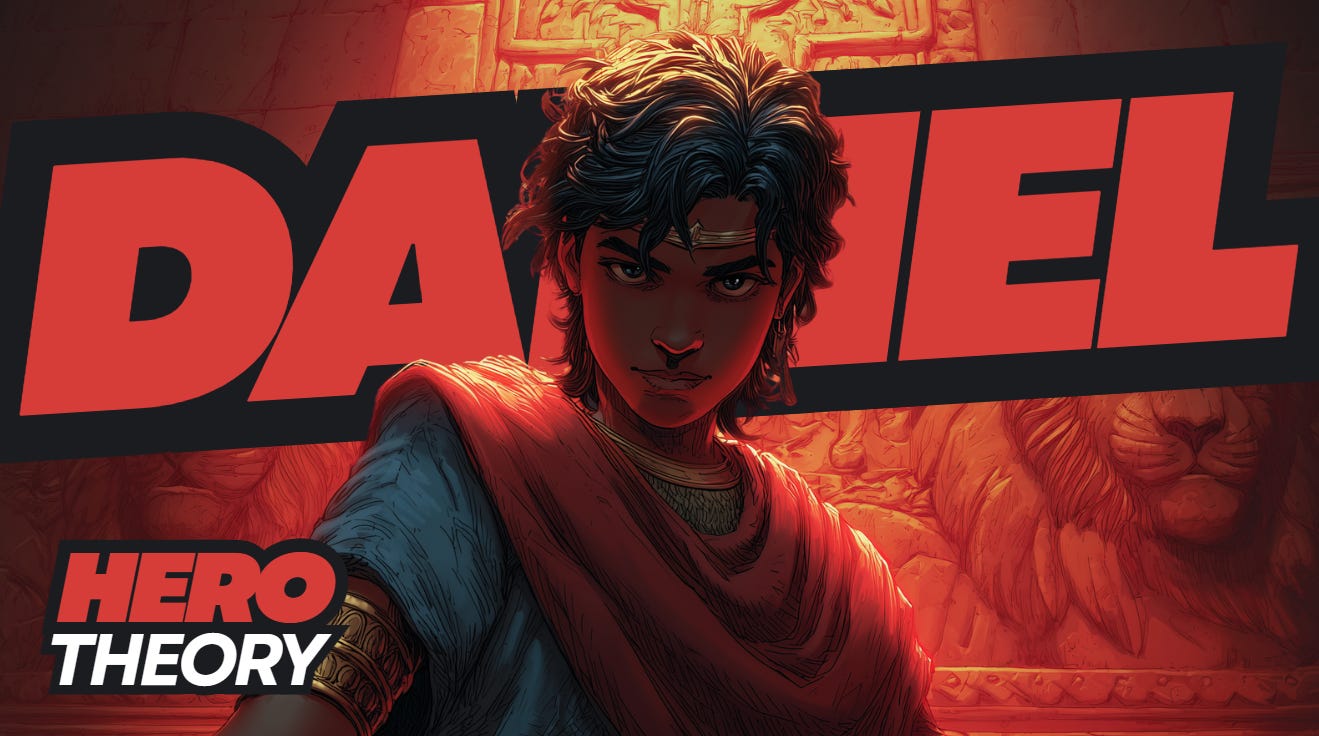
This is ancient Babylon. Walls thick enough for chariots to race along the top. Temples layered in gold and gods. Priests hunched over tablets of stars and omens, claiming to command fate. When they sacked Jerusalem, they took more than treasure, they gutted her future. They took teenagers, the sharpest, strongest, brightest, and remade them. Daniel was one of these teens, dragged from the smoke and ruins of his sacred home into the palace school, renamed, reprogrammed, and brainwashed in Babylonian science and sorcery.
It’s astonishing he didn’t disappear like all the others. He learned their language, their myths, their mathematics, their astrological arts, the best knowledge of the age. But he never gave Babylon his soul. A young man, cut off from family, separated from everything sane and good, he was offered survival and prestige if he only conformed.
Every drive in him, to belong, to rise, to prove himself, was weaponized by an enemy empire. But Daniel drew a line in his soul. He refused the king’s food. He kept his rhythm of prayer when prayer was outlawed. He used his stubbornness to build self-mastery.
Daniel found a way to do something incredibly hard with concentration camp-style guards outside his dorms and brutal taskmasters bulked to keep rebels in line. He stayed faithful in small things, every day, until it became unbreakable habit. That’s why the lions’ den mattered. For the Babylonian peoples, it was a theatrical execution, and a ritual sacrifice: defy us, and you’ll be devoured by the sacred lions of Ishtar, the signs of the king’s might and power over nature.
For Daniel, it was simply the next test. He had already faced lions—the lion of compromise, the lion of ambition, the lion of fear.
By the time they actually hurled him into a dark pit of lions, he had spent a lifetime becoming lord of himself. He didn’t fear the beasts snarling in the dark, because he’d already conquered them inside himself.
And in that moment, these monstrous, starving servants of the pagan gods, miraculously bent their heads, and brushed up against his hands. In that moments, God wanted the Babylonians to see something that would haunt their dreams for decades.
How can we become a man like Daniel?
His prayer life had forged him into iron. Each knee bent to the floor was another rep, another layer of spiritual armor. So when the real trial came, he didn’t have to search for courage, he had rehearsed it.
A lot of men right now are being sold a version of masculinity that looks like a lion pacing the cage: flashy cars, loud bravado, dominance at all costs. It’s bold, yes, but shallow. That’s not mastery, that’s performance. It’s power as theater.
If you stop there, you’re still ruled by the very thing you think you control. Daniel’s story shows a deeper path. He didn’t slaughter the lions, he mastered them.
Real manhood is being dangerous and disciplined—having the capacity for strength, but the clarity to keep it leashed. Not striking out at the wrong people. Not mistaking aggression for leadership.
The Daniel Challenge
Here’s the thing about anger, and aggression, and power. Men have it. They need it. If you have no capacity for aggression, you are not virtuous, you are harmless. And harmlessness is not strength. The question is: can you control it? Can you aim it?
So here’s the challenge. Pick one place in your life where the lion usually gets out. Maybe it’s traffic. Maybe it’s the way your child pushes back. Maybe it’s at work, when someone interrupts you. Don’t pick everything. Pick one. That’s where you’ll practice mastery, like your training ground.
Write it down on paper, in a journal, in a note-taking app. What will you do the next time you flip out and lose your temper?
When it next trips you up, stop. Don’t act immediately. Breathe for three full seconds, in through the nose, out through the nose.
This is not about suppressing your anger. You’re confronting it. You’re staring directly at the lion inside you, and you’re saying: I will decide where this goes.
Then, choose your action. Don’t default it. Maybe you excuse yourself to leave the room, or say “Let’s handle this later,” or “We’re doing something different this time.”
The key is this: choose the action that means strength under control, not strength out of control. It may mean speaking slowly instead of yelling. It might mean letting the insult pass because it isn’t worth answering. It might mean walking away.
But you choose. Not your temper. You.
And at the end of the day, write down how it went.
And re-read your commitment for seven days.
If you do that, day after day, you will become frightening in the best sense. Because a man who knows his own capacity for danger, but refuses to aim it at the undeserving, is not just safe. He’s trustworthy.
He’s the kind of man other people can rely on when the lions really come.
About Hero Theory
Hero Theory isn’t about being the toughest guy in the room. It’s about being the most ready—ready to do the right thing when no one else will. Ready to speak up, step in, and stand firm, even if your hands are shaking. All it takes is 20 seconds of insane courage to change a moment… and maybe even your life.
You can practice that kind of courage. Let's explore what that looks like: the habits, the mindset, the mentors, the fictional heroes and the real-life ones. So when your moment comes, you don’t hesitate. You act. Because that’s who you’ve trained to be.