


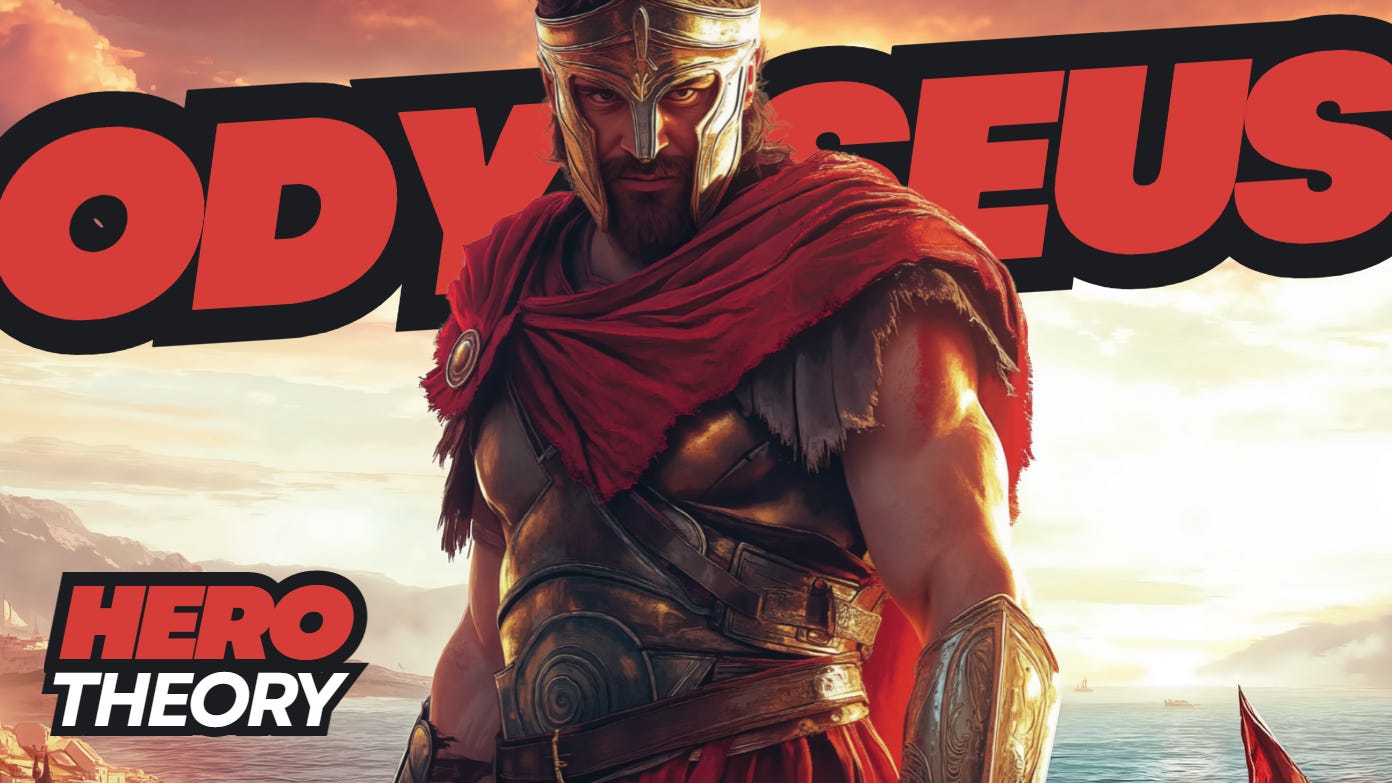
Odysseus comes from Ithaca, a hard, stingy island at the edge of a Mycenaean world going brittle from battlefronts. This is the Late Bronze Age: palaces run like war-corporations, herds tallied in clay tablets, oxhide copper ingots stacked in storerooms, ships sliding along wine-dark trade corridors between Crete, Egypt, the Levant.
Homer calls Odysseus polytropos—many-turning. Not just clever. Curved. A mind that moves like a school of fish. Look at his bloodline: his grandfather Autolycus was a thief favored by Hermes, the god of travelers, liars, and luck. Odysseus is born into that weather: half storm, half brain.
Even his name carries friction: from odussomai, to be angered, to cause pain. He’s the man trouble clings to, and the man who knows how to make trouble work for him.
Ithaca forces that out of him. It’s not a fat kingdom; it’s a rock with goats. You can’t win there by muscle. You win by reading wind, calculating tides, keeping track of who owes you what across a web of guest-friendships that stretch from hut to throne room. This is the world of xenia—sacred hospitality—where a stranger under your roof becomes a kind of brother. Break that code and Zeus takes notice. Keep it, and doors open in the next harbor. Odysseus builds his life on that invisible network; it’s his insurance policy in a violent world.
And then the siege of Troy summons an alliance of demigods, generals, warriors, and soldiers. Ten years turns men into blunt, exhausted tools.
Odysseus is the weird counter-current: the one still thinking when everyone else can only swing a blade. He recommends the giant wooden horse as the last move in the game, a fake surrender, a tribute to Athena to grant them all safe passage home. He knows the Trojans will want to desecrate it, own it, and ensure they never return to attack again. And so he plays his trap masterfully. Troy falls days later, and the war galleys make a taut turn behind the headland, and rush the walls.
That’s when his adventures gets worse, and troubles fly at him from right and left. There’s no time to plan, to think, to prepare. He must react right on the edge of danger, and he must not fail. This kind of knife-edge response comes from years of training your mind, preparing your soul, so that your team can count on you when all other lights go out.
The gods of his return sea voyage aren’t metaphors; they are the elements themselves. Poseidon in every broken wave that wants to flip your ship, Athena in the sudden, surgical thought that saves your crew. Odysseus struggles to stagger between them: the soldier of strategy patroned by the goddess of craft, hunted by the god he offended when he blinded a one-eyed son.
He faces Lotus-Eaters, numbed from the world’s pain into a soft couch of oblivion where men trade memory for food and naps. The Sirens promise praise, offering the joy of perfect knowledge and fame if you just steer your life into their greedy teeth. Scylla and Charybdis is the awful cost of leadership, when every option costs blood: choose the narrow passage, lose a few, save the many, and live with the screams in your dreams forever. Calypso’s island is cruelest of all: eternal comfort offered by a goddess who loves you. No taxes, no storms, no battles… all the creature comforts you desire, along with the slow death of purpose.
Odysseus skirts the edge of each one, fumbles and fails forward through these adventures, because he understands nostos: the hero’s long, dangerous return (usually by sea) and the restoration of his house and name. He has a noble call to restore of order—of a man, a marriage, a household, a kingdom. He is called to be a man, and to become a good man. Immortality and ease are distractions that could destroy him.
That’s why Athena backs him. Not because he’s perfect, but because he keeps choosing the hard loyalty—crew before comfort, home before glory, Penelope’s fidelity over Calypso’s golden cage. When he disguises himself as a beggar and walks into his own hall, he is doing more than setting a trap; he is measuring the rot. The suitors are the sewer rats of a kingdom without its king: hospitality twisted into theft, strength turned into swagger, men devouring the future of the house because no one will check them.
He draws the bow and restores order.
Odysseus isn’t just clever; he’s conditioned. He doesn’t invent brilliance on the spot, he trains his body to respond before panic hijacks him. The challenge is to rehearse micro-choices until they’re reflexive.
The Odysseus Challenge
When you face a decision, the worst thing you can do is drift. Indecision is a form of self-betrayal—it means you’re allowing fear, or the fantasy of the perfect outcome, to take control of your life. The world doesn’t wait for you to get it right; it punishes hesitation just as much as it punishes recklessness.
Odysseus knew this. Every island, every storm, every monstrous choice demanded that he act. He didn’t have the luxury of circling back endlessly. He made a decision, and then another, and then another.
Your challenge is this: when a decision confronts you, stop. Take two deliberate breaths. On the first, admit the temptation to postpone, to keep yourself “safe” in paralysis.
On the second, focus the question: Which option carries me closer to my highest aim, even if it is difficult? Then pick an option, and do it. You are training yourself to act and move, to break out of inaction.
Practice doing this for seven days. Write down what you will do, and read it every day.
Start with small matters: ordering a meal, choosing the next task, speaking a truth you’d rather avoid. That’s practice for the larger ordeals where the cost will be real, where quick decisions will be needed to create freedom and safety for others.
First: you’ll notice hesitation becoming more obvious.
Second: you’ll begin to experience a sharper sense of time. Decisions that once dragged into hours or days will collapse into minutes. Most choices don’t require perfect information. They just need enough information, and a dash of courage.
Third: when you make quick decisions, you can’t hide behind “I didn’t know” or “I couldn’t choose.” That pressure can be uncomfortable, but it’s also energizing. You’ll also decide more quickly to stop what doesn’t work. You’ll decide to start faster what is good for you. You’ll build a steadier spine.
We do the best we can, and when we know better, we do better.
About Hero Theory
Hero Theory isn’t about being the toughest guy in the room. It’s about being the most ready—ready to do the right thing when no one else will. Ready to speak up, step in, and stand firm, even if your hands are shaking. All it takes is 20 seconds of insane courage to change a moment… and maybe even your life.
You can practice that kind of courage. Let's explore what that looks like: the habits, the mindset, the mentors, the fictional heroes and the real-life ones. So when your moment comes, you don’t hesitate. You act. Because that’s who you’ve trained to be.
This is great, Dominic! Thanks