


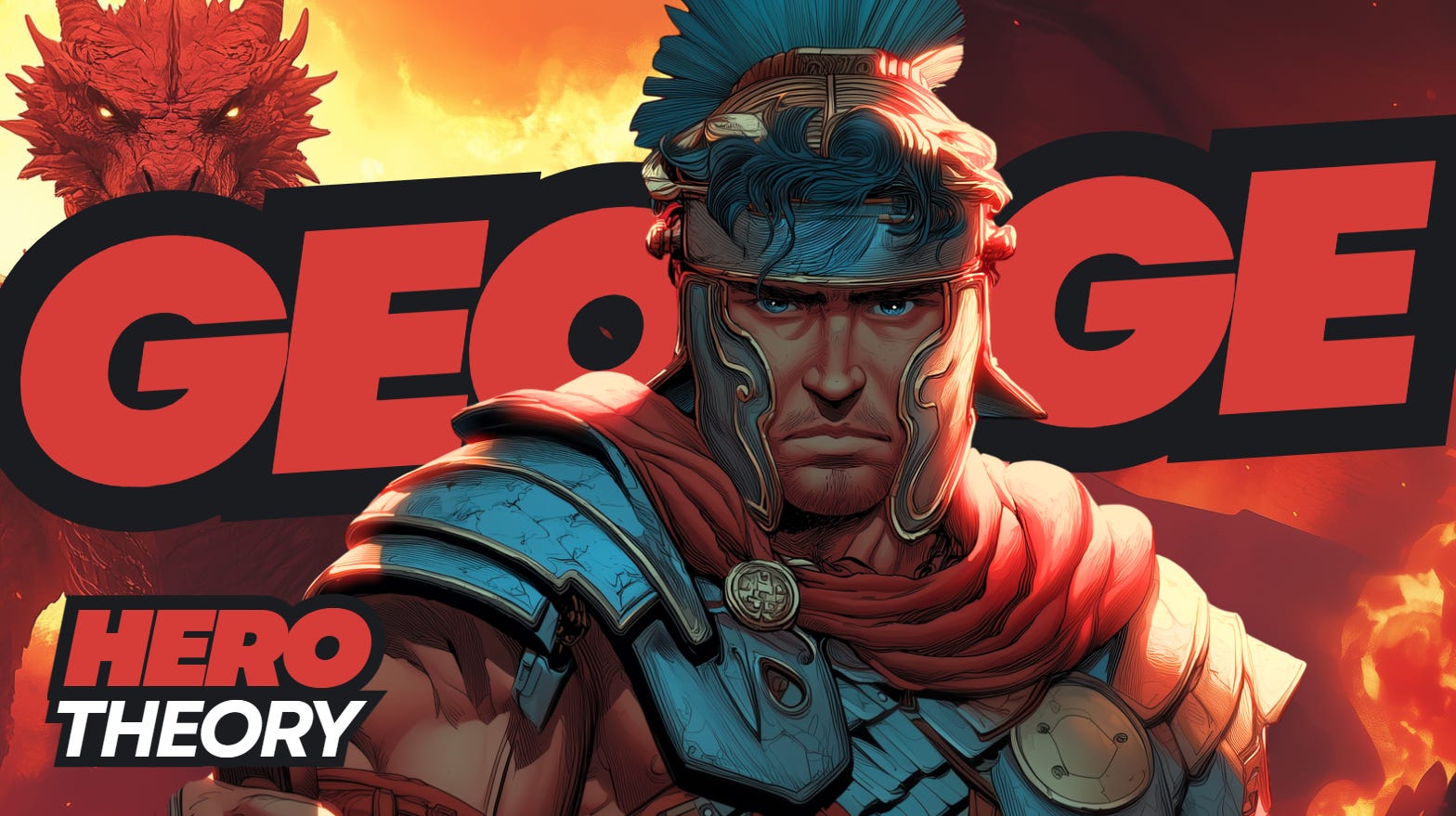
The Roman empire was a massive machine. Rome fed its legions with grain from Egypt, its palaces with taxes from Syria, its gods with smoke from every hand. And George was a cog in that machine: a stormtrooper with polished armor, scarred sword, and decades of discipline obeying orders.
He wasn’t a monk. He was a soldier. George. His name in Greek meant farmer. A man of the soil. But Rome made him a soldier. Born in Cappadocia, raised in Palestine after his father’s death, he put on the armor of the empire, swore the oath, trained in formation, marched under the Eagle. Rome gave him his identity: rank, pay, the respect of men, the rhythm of drill and campaign.
But in 303 the emperor issued the edict: every Christian must sacrifice to the gods. Soldiers were the first tested, because if the army cracked, the empire cracked.: burn incense, pour wine, honor the gods, honor the emperor. One pinch of incense. One gesture.
It was nothing, and for George, it became everything. Because George had another confession on his lips: Christos Kyrios. Christ is Lord. The God-Man who bled under the same empire’s nails.
Now he had to decide what he would kneel to. Rome or Christ.
He sold everything, gave it to the poor, then walked into the emperor’s presence, took the written decree, and ripped it in half. And in that silence, in front of Diocletian himself, he confessed his faith in Christ.
He knew what it meant. Torture. Prison. Imagine him: a centurion’s bearing, shoulders squared from years of battle, stripped of rank, standing before a tribunal that was once his home. These were his commanders. His brothers-in-arms. They demanded a soldier’s loyalty. And George said no. No incense. No betrayal of the God above all gods.
Rome tried to break this farmer with torture. He held the line with a soldier’s grit. And then they beheaded him.
That’s why his name survived the empire. Because George showed what it means for a man to square his shoulders when the entire world tells him to bow.
Centuries after, his name spread across the Mediterranean. Pilgrims knew his shrine at Lydda. His story was sung in Byzantium. And when the Middle Ages needed images to preach courage, they reached for George.
That’s when the dragon appears. In the pulpits and manuscripts of the 11th–13th centuries, the Legenda Aurea. A princess, dressed in white, is led out to be devoured by a dragon that haunts her city. She is possibly the image of the Church, the Bride of Christ. The dragon is the devil, yes, but also every empire that demanded worship, every terror that tries to own men’s souls.
George rides in as a mounted soldier, a knight. Mail, lance, warhorse. He spears the dragon, pins it down, and delivers the bride. To the medievals, this wasn’t fairy tale fluff. It was the soldier-martyr’s defiance retold in symbols that made sense. It was Rome, reimagined as a beast. It was faith, fragile and feminine, preserved by the blood of men who refused to kneel.
In an age where men marched under banners and pledged fealty to kings, George became the banner-bearer of Christendom. His red cross on white cloth, the sign of the Crusaders, spread across Europe. Knights wore it on their shields. Kings invoked him before battle. English monarchs made him their patron. He was the archetype: a warrior whose greatest battle was mastering his own soul.
Every man has dragons circling his life. Fear. Lust. Addiction. The suffocating pressure to give the pinch of incense to culture.
The bride of your soul is still there: faith, integrity, the presence of something worth guarding. Something that does not exist without your backbone safeguarding it.
The medieval storytellers weren’t softening George’s story. They were translating it—so that men in castles and boys in villages could see with their eyes what fidelity looks like when it bleeds.
The George Challenge
Grab your journal, or a sticky note, and write down the one thing you do not want to happen again. One sentence: “I will not ___.”
No sucky fluff here.
“I will not look at porn.”
“I will not bad-mouth my wife to my friends.”
“I don’t want to be a wimp.”
Writing this down is not an attempt to muscle yourself into self-mastery. It’s to identify the thing you don’t want to do.
Calling out negatives doesn’t fix things. You have to want a positive to replace it. Pick the thing you do want to become. For example:
“I want to be a good man.”
“I will be a support to my friends when they need help.”
“I will excel at my work, and build up those around me.”
Read that every day, and then train for it. Say no to something small every single day. Skip the extra drink. Close the screen. Bite your tongue when gossip comes easy. Tiny refusals are how you sharpen your attention.
Say yes to things you should do, and don’t put them off. Train yourself to get it done, no complaints, no delays, no excuses.
That way when the real test comes, the one that costs you more than getting up from the couch, you’ve already practiced your decision a hundred times.
Pro tip: don’t do it alone. Tag one brother, one friend you trust, and let him ask you if you’re holding the line. Chances are that you both need to work on it. Most men do. A soldier with a shield-mate doubles their survival chances.
Courage isn’t improvised. It’s rehearsed. George stood tall because he’d already decided who he wanted to be.
About Hero Theory
Hero Theory isn’t about being the toughest guy in the room. It’s about being the most ready—ready to do the right thing when no one else will. Ready to speak up, step in, and stand firm, even if your hands are shaking. All it takes is 20 seconds of insane courage to change a moment… and maybe even your life.
You can practice that kind of courage. Let's explore what that looks like: the habits, the mindset, the mentors, the fictional heroes and the real-life ones. So when your moment comes, you don’t hesitate. You act. Because that’s who you’ve trained to be.