


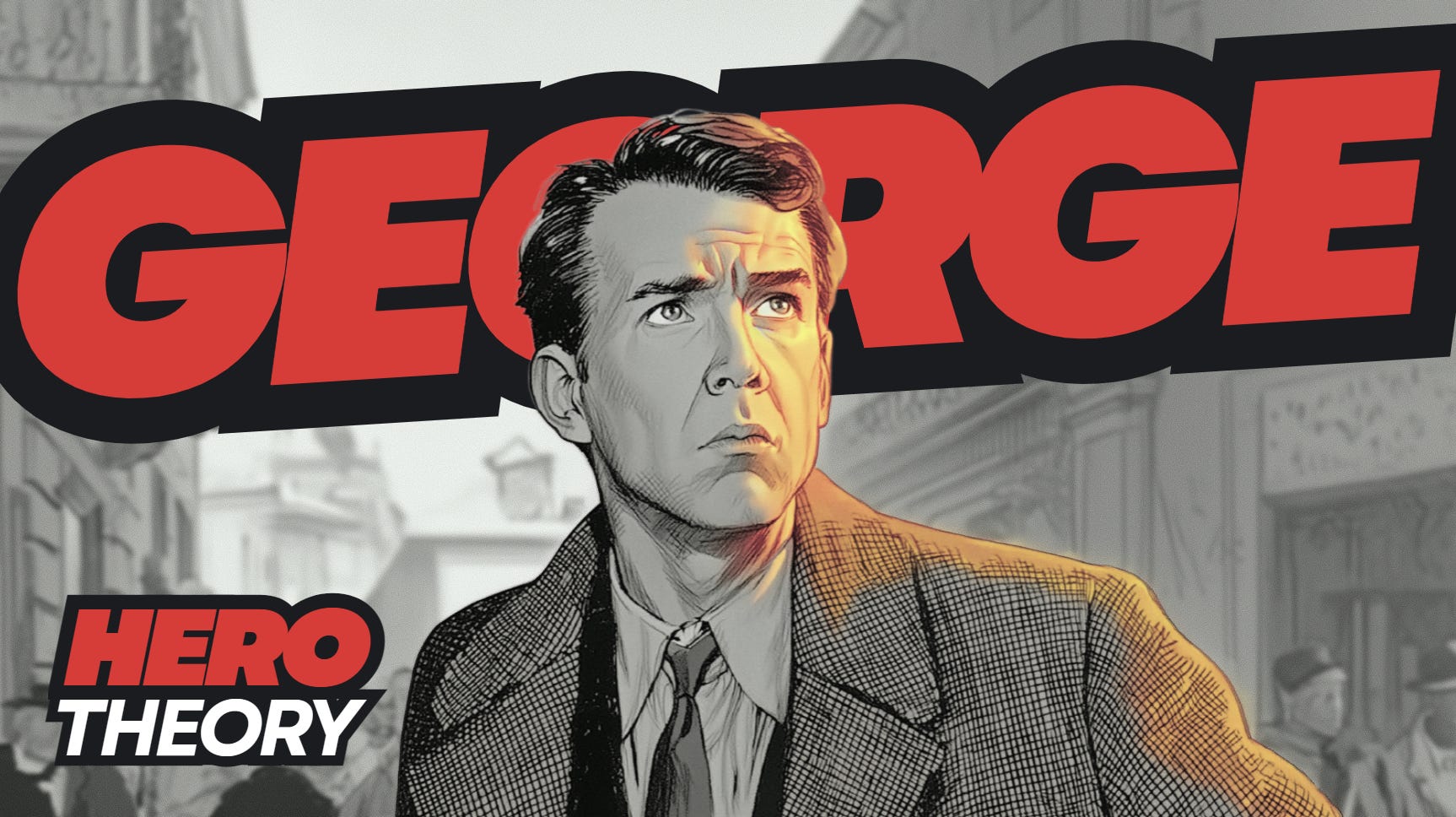
George Bailey dreamed of living large. Travelling the world, building skyscrapers. he wanted to make a name for himself. But instead, a few small asks, a couple of unexpected moments, and he stayed home. And like Bruce Wayne, he falls into a well in his soul, a dark place that slowly eats at him, driving him to miss all the good things in his life, pushing him to the brink of a bridge on a dark winter night.
Most of us won’t get statues in the town square. Most of us won’t lead armies or win Olympic trophies. But every man has a Bedford Falls. It’s your circle. Your family. Your block. That’s where the most important story in your life plays out.
The staying almost broke him. His enemy wasn’t just Mr. Potter, the man in the corner office, the one squeezing neighbors dry and buying up the town.
His enemy was the voice that kept whispering: your life is too small. You’ve wasted it.
But George’s greatness wasn’t in the adventures he missed. It was in the fights he chose.
Every time Potter offered an easy way out, George fought with himself like an addict offered another hit, a drink pushed in front of a recovering drunk. It took all his willpower to turn down his dreams, to show back up for the people who needed him.
He felt like he was losing everything to do the right thing. He was losing time, losing his life, and settling for scraps. He couldn’t see the warmth and the trust he was weaving around himself.
Look at his crew around him. None of them were power brokers or celebrities. His friends were regular men: Ernie the cabbie, Bert the cop. Violet, written off by everyone else. Uncle Billy, fumbling but loyal. And Mary, who anchored George when he was about to break. They needed George to show up. And he did, again and again, even when maybe he didn’t know why.
And he almost missed it. Almost missed out on everything.
Standing on that bridge, he was ready to throw it all away. It would have been easy. All that build up of painful failure pressing on his throat.
A lot of men today feel like that, shadows in their own lives. Abandoned by fathers, overlooked by mentors, chewed up by systems that don’t care if they make it or not. You grind at a job, you show up for your family, and maybe you still feel invisible. Like nothing you do registers.
Stories like George Bailey remind us of the truth: you do matter. Even if no one sees. Even if they never clap. The work still counts.
The shape you make in the world needs you in it. Maybe you need to ask for help, find a friend, call an old buddy. Maybe the escape route out of your loneliness is to step up and be a friend to someone else, to ask them for help.
George Bailey stayed because people needed him. And he learned how much he was needed, the one time he broke down, and finally asked for help.
The George Bailey Challenge
Pick three ordinary moments in your day: when you wake up, when you eat, when you shut the lights off. These will become your triggers.
Every time one happens, stop for a full breath. Pay attention to it. Doesn’t matter how small. With the breath in your lungs, make an act of gratitude for everything good that is happening in that moment. Could be the roof over your head, the coffee in the mug, a single friend who hasn’t bailed. Everything good.
Genuinely bad things may be going down. That’s life. Your challenge is to hold the line of gratitude anyway, and train your awareness to also see the good things.
This is rep work. Neuroscience shows gratitude rewires your brain—shifts you from scarcity and despair to strength and abundance. But you only get the wiring if you run the drill. Discipline makes gratitude muscle memory.
Pick three things you do every day, and write them down, put them as a reminder on your phone. It will be clunky at first, but that’s ok. You’re building a habit.
Do this for seven days.
I guarantee you’ll start to see a difference: the world will not feel as empty and bleak. Gratitude becomes your armor, part of your shield of faith.
About Hero Theory
Hero Theory isn’t about being the toughest guy in the room. It’s about being the most ready—ready to do the right thing when no one else will. Ready to speak up, step in, and stand firm, even if your hands are shaking. All it takes is 20 seconds of insane courage to change a moment… and maybe even your life.
You can practice that kind of courage. Let's explore what that looks like: the habits, the mindset, the mentors, the fictional heroes and the real-life ones. So when your moment comes, you don’t hesitate. You act. Because that’s who you’ve trained to be.
thank you ... never thought about George Bailey as a role model in this way