


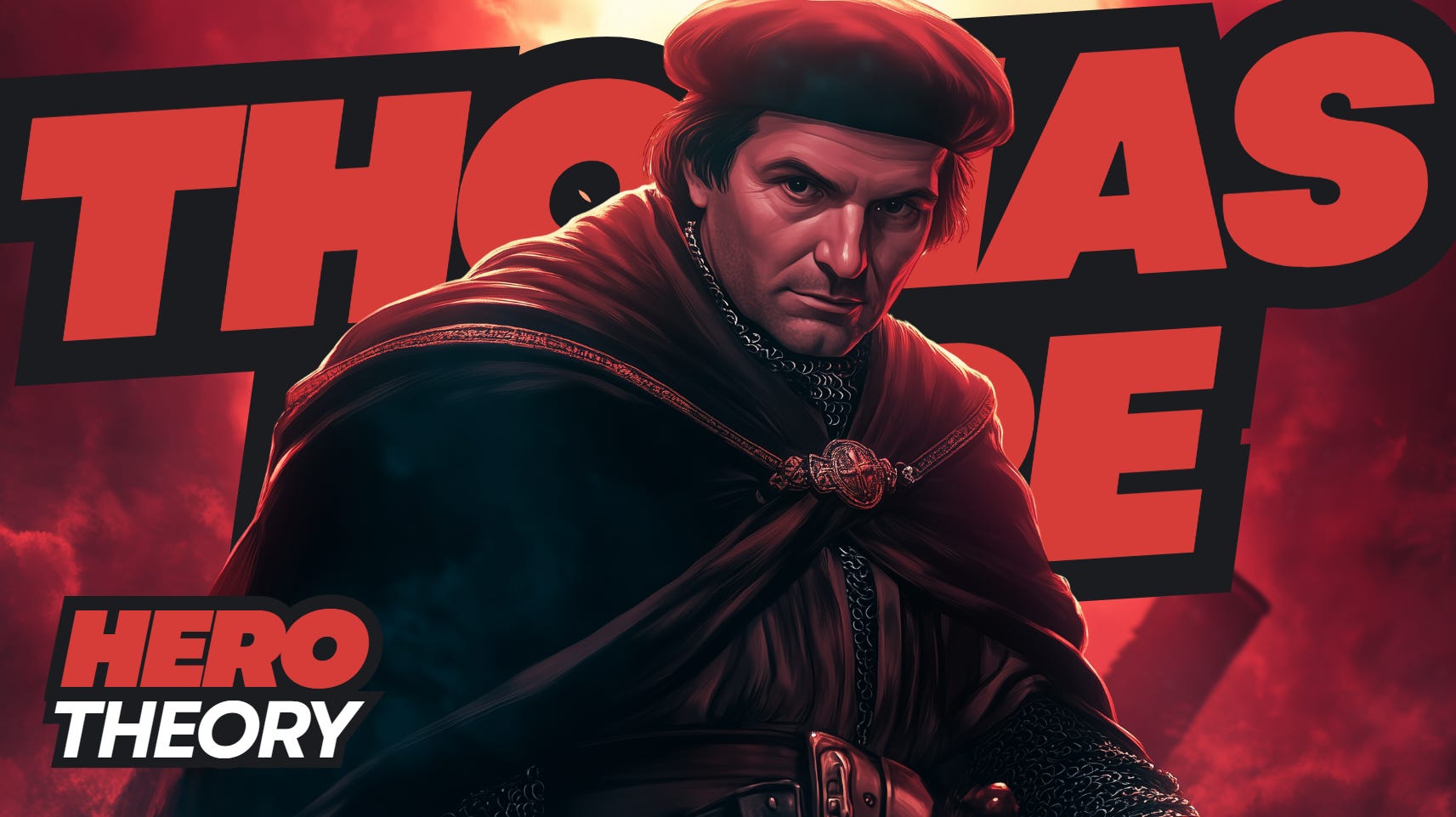
In 1530 England, the air is charged with unease. Ships are pushing across the Atlantic into the New World, scholars are poring over Plato and Cicero, and the printing press is turning universities inside out, putting learning and Luther’s defiance in the hands of anyone who can read or read aloud.
At the center of this storm stands King Henry VIII, a king desperate for a son, furious that Rome won’t untie his marriage to Catherine of Aragon. His solution is to dislocate the English church from allegiance to the Pope, and crown himself supreme.
Right beside him, until he couldn’t be, is Thomas More. Lawyer, scholar, wit, he is Henry’s friend. A man who once wrote Utopia, probing what a just society could look like. A man who rose to become Lord Chancellor of England, second only to the king.
At this time, the clergy has already been forced to admit Henry as “supreme head… as far as the law of Christ allows.” That’s lawyerly air cover, a hedge. But the campaign keeps advancing: restraint of appeals to Rome; the realm declared an “empire”; the King’s courts now the last stop for souls as well as suits. By 1534, Parliament adds fresh teeth: make the wrong speech about supremacy, and your words are treason.
The Wars of the Roses are only a lifetime behind him. Every courtier can imagine England slipping back into faction and blood.
Thomas More’s job was to keep the country together, and in those days, heresy and treason were close allies. Especially with a king edging toward becoming his own pope. Humanists grumble that religion is bloated with superstition; radicals smuggle books that say a plowman, Bible in hand, can tell a bishop he’s wrong, and Luther’s idea unravel the body of Christendom into warring factions of princes and prelates. ‘Heresy’ was not edgy thought, but a solvent poured on the load-bearing walls of a sacramental society.
When he prosecutes heresy as Chancellor, More isn’t crushing free thought; he’s holding the country together, the way a mason braces a cracked arch. Heresy is a contagion that unravels law, oath, and sacrament.
More believes deeply in the medieval Catholic order, with the Pope at its center, king and country was your identity. Dissent crushed for the sake of safety.
So when the Crown presents the Oath, More reads it like a lawyer, a theologian, and a man with a soul on the line. Could he swear to the succession? Yes. He’d already told friends he could live with a statute settling the crown. But the preamble? That’s where his pen stalls. It requires him to deny papal jurisdiction and affirm a chain of claims he cannot bind to God’s name without, in his mind, lying to God.
More was a lawyer to the bone, and oaths weren’t casual. To him, an oath was sacred, binding before God. To swear what he didn’t believe would be to damn himself.
He tried to walk a razor’s edge: silent enough to avoid treason, firm enough to keep his conscience intact. Silence as shield. Silence as protest. We see a king who fears dynastic chaos more than excommunication, and a counselor who fears perjury more than death. But Henry’s paranoia saw silence as defiance.
More was sent to the Tower.
He’s not playing the hero; he’s trying to thread a needle. He refuses to rail against the King; he even blesses Henry’s health and Anne’s welfare. He prays for his judges.
He keeps the circle of his conscience small—family, sacrament, Scripture, the undivided Church he still believes exists across borders. This is not modern individualism. It’s a medieval conscience inside a Renaissance mind. He trusts that truth is real, and oaths either align to it or break your soul.
More’s life is a brutal reminder: you can’t fake an oath. You can’t lie to your own soul and walk away whole.
The Thomas More Challenge
Being a man of your word means you have integrity. People know what they’ll get when they deal with you. It builds a gravity field around you: trust, predictability, a kind of strength. More’s enemies hated him, but they trusted he wouldn’t lie.
For a man today, it means you stop living split. No hidden caveats, no half-promises, no “I’ll try.” When you speak, people relax or brace because they know you’ll follow through. That consistency is rarer than talent or charisma. It makes you someone others can anchor to in chaos.
Be slow to promise, and ruthless about keeping the promises you do make. In a world where words slip like water, treat yours like steel. Say fewer things. Mean it more. When you agree, you make the quiet decision to move heaven and earth to deliver—unless you discover it’s truly wrong to do, or truly impossible. Those are the only two exits. Everything else is weather. You push through weather.
Over the next seven days, practice doing what you promise. Do it well, and don’t look for a reward.
Your word becomes a kind of currency—hard, dependable, not inflated by excuses. Opportunities start to find you, because others know that if you say yes, it’s as good as done. And inside, you feel a steadiness grow; you don’t have to juggle masks or scramble for cover stories, because your life matches your mouth. Every time you keep a promise, no matter how small, you weld another plate of armor onto your character. Over years, that adds up to something rare: a reputation that outlives you.
About Hero Theory
Hero Theory isn’t about being the toughest guy in the room. It’s about being the most ready—ready to do the right thing when no one else will. Ready to speak up, step in, and stand firm, even if your hands are shaking. All it takes is 20 seconds of insane courage to change a moment… and maybe even your life.
You can practice that kind of courage. Let's explore what that looks like: the habits, the mindset, the mentors, the fictional heroes and the real-life ones. So when your moment comes, you don’t hesitate. You act. Because that’s who you’ve trained to be.
Let your 'yes' be 'yes' and your 'no', 'no'