


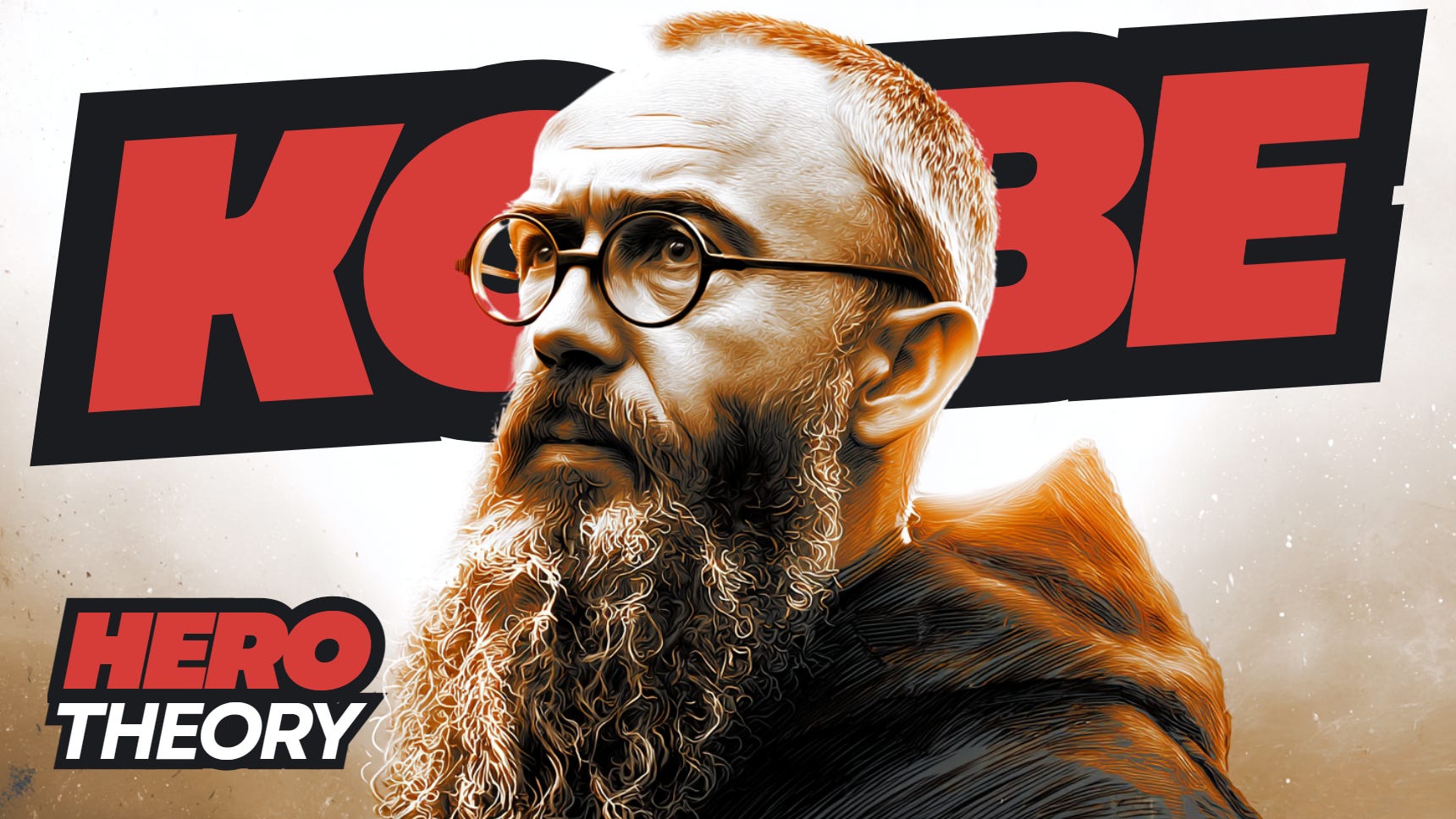
Imagine this Polish boy, ten years old, staring into a vision. A vision that would hang over his whole life like a quiet countdown. He says the Virgin Mary appears to him, holding two crowns. One white, one red. The white means purity. The red means martyrdom. And she asks him which he chooses. He says, “Both.”
And that’s not just the whim of a boy who doesn’t know better. At ten years old, that was already Maximilian Kolbe’s way of living. Saying yes to the hard path.
Kolbe grows up in a Poland under intense pressure. His father is executed fighting for independence in the Polish Legions. He joins the Franciscans, becomes a priest, and builds a publishing house so massive they call it the “City of the Immaculata.” He prints staggering numbers of magazine, starts a radio station, and even launches missions overseas. He’s relentless.
He’s training his mind, his brothers, his people. He’s shaping habits of courage, discipline, and devotion. He’s not playing small. He’s saying: if you’ve got a calling, live it with your whole life.
And then the Nazis march in. 1939. The world goes black and red. The cleansing machine of gas camps gets underway, fed by overloaded trains that squeal through the days and nights of local villages. Most people close their windows and keep their heads down.
Kolbe doesn’t. He shelters Jews, feeds refugees, even running a temporary hospital right up until he’s arrested, beaten, and thrown into Auschwitz. Stripped of his name, he is branded 16670. He’s starving, whipped, made to haul stone until his body can’t handle it any more.
But he doesn’t stop being a priest. After hours, he celebrates Mass, hears confessions, whispers prayers with condemned men. When others collapse into despair, he becomes a shepherd of hope in hell.
That’s not just good genes. That’s a habit. That’s twenty years of training in prayer, purity, and sacrifice. His early yes to Mary’s crowns shows up here: when life narrows to nothing, he already knows how to live, because he practice.
Then a prisoner escapes. The commandant lines up the men, commands a brutal, routine punishment to deter future escapeees. Ten men must will die in the starvation bunker.
One man, Franciszek Gajowniczek, begs for mercy, for the sake of his wife and children. Kolbe steps forward. He doesn’t hesitate. He doesn’t grandstand. He just volunteers: “I am a Catholic priest. Let me take his place.”
The boy who chose both crowns became the man who chose another man’s death.
In the bunker, they sit in the stinking dark for two weeks with no food, no water, no relief. Kolbe keeps his head, leads prayers, starts hymns. He turns a starvation cell into a chapel.
When the guards finally enter, everyone has keeled over, dead. He’s still the last one alive. And he’s calm. They kill him with a syringe of carbolic acid. He dies August 14th, 1941, the eve of Mary’s Assumption.
Kolbe didn’t just decide one day to be heroic. He trained himself. Trained to die to himself, to surrender his comfort, to let his devotion shape him. When the impossible moment came, it wasn’t impossible anymore. He was ready.
The Kolbe Challenge
Practice sacrifice in the small things, so when the great moment comes, you’re ready.
Here’s how: every day this week, give something up for someone else—your time, your comfort, your food, your ego. Don’t wait to be asked. Offer it. Volunteer. And don’t ask for any acknowledgement or praise.
Journal what you did every day. It’s important to keep it fresh in your mind and your attention. Pray to St Maximilian to inspire your attention, and help you to do it well.
You’re preparing for the day when somebody else cries out in need, and you’re the one who needs to step forward.
About Hero Theory
Hero Theory isn’t about being the toughest guy in the room. It’s about being the most ready—ready to do the right thing when no one else will. Ready to speak up, step in, and stand firm, even if your hands are shaking. All it takes is 20 seconds of insane courage to change a moment… and maybe even your life.
You can practice that kind of courage. Let's explore what that looks like: the habits, the mindset, the mentors, the fictional heroes and the real-life ones. So when your moment comes, you don’t hesitate. You act. Because that’s who you’ve trained to be.