


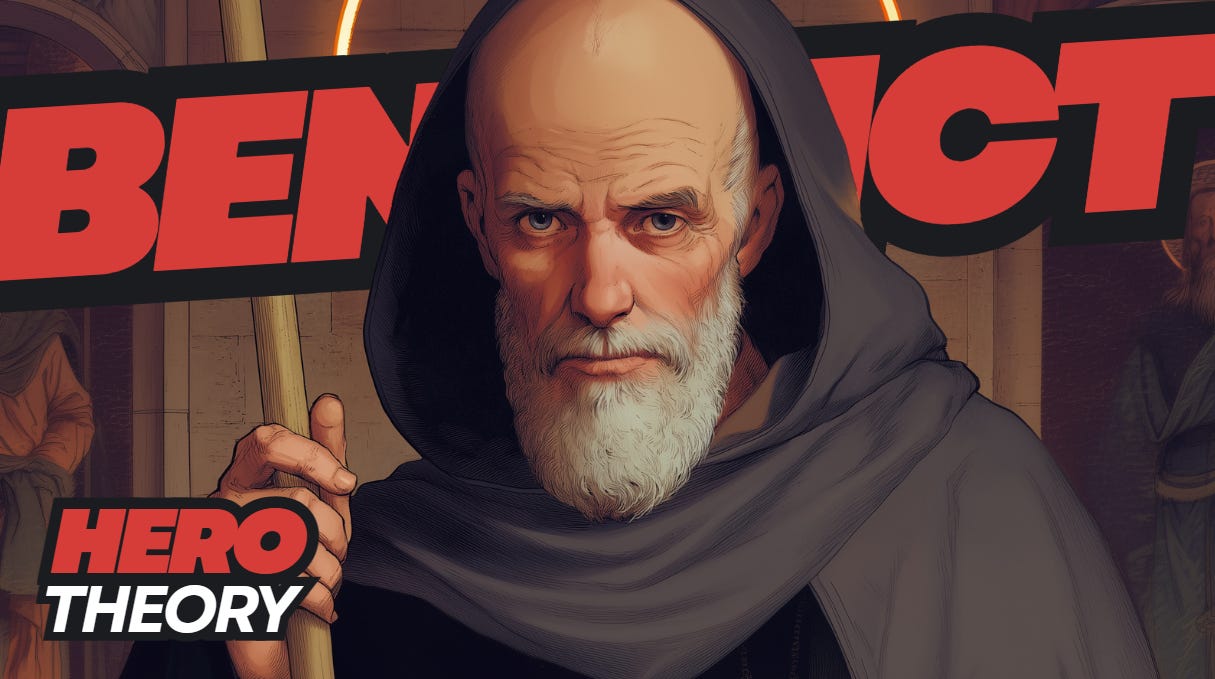
It is the year 480. Rome’s emperors are finished, but the world hasn’t collapsed into nothing. Italy is ruled by Odoacer, then by Theodoric the Ostrogoth. The Senate still meets, laws are still read out, old Roman structures still stand. Civilization hasn’t died, it’s limping along in a fragile, hybrid state. That’s the air Benedict is born into: banditry on roads, land seizures, peasants conscripted or enslaved by passing armies. Violence was ambient, not exceptional.
As a teenager, he’s sent to Rome. He could’ve chased the noble path—status, law, politics. The system still worked for men like him. But something in him rebelled against the city’s distractions and vanity. Gregory the Great says he left because of corruption and vice. Whatever the reason, he rejected a future that could have been successful, and we would have never heard of him again.
He disappears into Subiaco, into a cave, mentored by an old hermit. He spends three years in silence, hunger, and prayer. It changes him, turns his spiritual life from a puddle into a deep well, and it becomes so real you can feel it. Men show up, asking him to lead them, to teach what he has learned. They want what he has. He agrees.
But the Rule he lived by challenges them, and some even tried to poison him. Benedict provokes resistance. Holiness makes him real, because he knows the stakes.
This is an era of warlords, shifting allegiances, and collapsing civic structures. Benedict’s insistence on rootedness and hierarchy created mini-societies where order and loyalty could survive the chaos outside. No one knew what next year would be like, or what new empire would rule the world. He decided to train men to hold steady, no matter how fractured the world became.
He gathers groups of men into monasteries, a first twelve houses, twelve monks each. he did not want to start a spiritual empire, or a monument to himself. He planted cells of resilience instead. He taught commitment to a specific place, to a community of persons, and to the presence of Christ.
Eventually, he climbs Monte Cassino. There was an old Roman temple there, probably dedicated to Apollo. With typical early Church flair, Benedict smashed the idol and built a chapel in their place. We can assume the local pagans weren’t too happy, but this monastery of monks weren’t pushovers. They were hardened by daily work and consistent prayer. The pagans gave way, and Benedict claimed the area for the healing grace of Christ and the Kingdom.
At Cassino, he writes his Rule. He wasn’t inventing monasticism for the first time. The East had been at it for centuries with their brutal and beautiful asceticism, and even in the West there were older rules—like the harsher Rule of the Master mixed in with lax rule-followers.
Benedict sought balance, to avoid the typical stoic extremes and rigorism that usually follows renewal. Wine is allowed, rest is allowed, the sick are cared for, the old respected. Work and prayer. Prayer and work. A rhythm tough enough to survive famine, plague, and war, and humane enough to heal humans and create thriving community.
His Rule is a psychological and social technology: balance instead of extremism, rootedness instead of restlessness, rhythm instead of chaos. It sustains because it is realistic about human weakness and tough enough to endure historic disruption.
Gregory recounts many of his miracles—prophecies, foresight, mind-reading. These reveal Benedict’s piercing discernment, able to see through people and their games. That kind of insight unsettles some, and it attracts others.
His death is painted like his life: on purpose. He died on his feet, supported by his brothers, receiving communion. Upright and focused on his first love, all the way to the end.
The Benedict Challenge
Pick one place, and stay there every day for seven days. It can be a chair, a corner of your room, a bench outside. No phone, no distractions. Just sit, breathe, pray a prayer of your choice. Something simple. Start a timer, and stay still for 5 minutes. Don’t move when you feel restless. Don’t reach for escape. Train yourself to remain.
What does this do to you? Inside, your soul starts to steady. You are retraining the itch to run. Silence will no longer scare you. You stop being tossed around by every urge, every distraction, every mood swing, every notification.
And people will notice. They’ll also start to feel a new gravity in you, a man not always rushing or scattered, but grounded, unflinching, able to hold still when others are floundering everywhere.
Rootedness shows. It’s calmness in your eyes, steadiness in your word.
Seven days, one place, 5 minutes.
Download the 'Hero Theory' e-book: 25 short stories to inspire young men to seek heroism

Young men today feel stuck in training mode in a basement: unwanted, lonely, and unprepared when life demands courage.
day 1, 1 place, 5 minutes - done ... Lord, help me do this 6 more days!!