


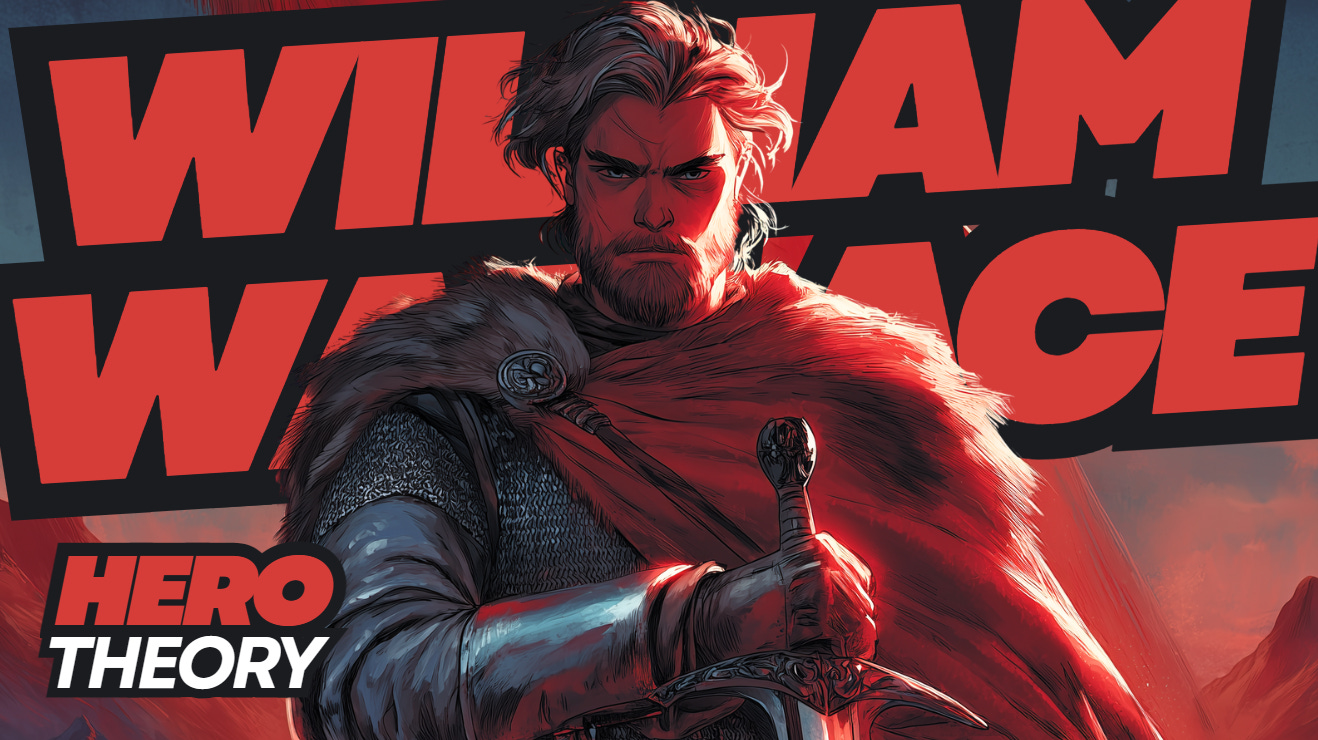
Before he ever picked up a sword, William Wallace’s world was fields and abbeys, stone walls and river crossings. He grew up in Elderslie, Renfrewshire, the son of a lesser noble, surrounded by farmland, a world where the smell of peat fires hung heavy in the morning mist.
His education was shaped by the local Church—he likely learned his letters from clerics, memorized Latin prayers scratched into wax tablets, and heard the bell tower call him from study to Mass. Imagine a boy walking the worn cloisters, running a hand along cold stone, reciting psalms he half-understood and felt deep in his chest. He fished the streams, watched cattle graze, and hummed the rhythm of a land that belonged to God before it belonged to kings.
That formation, books, bells, and the brilliant, moody edge of the Scottish countryside, was the soil that raised a man who refused to bow when the storm came.
What made Wallace’s stand so haunting was the tragedy of brothers in the same faith turning swords on each other. England and Scotland were both Catholic, both bound to Rome, both hearing the same Mass and confessing the same creed. And yet one king pushed his claim north, over another’s conscience. That is what burned: a war of Christians against Christians, altars shared on Sunday, blades drawn on Monday. In that world, your conscience was the last refuge. When banners and bishops spoke with many voices, a man’s spine had to carry the weight of clarity.
King Edward from England believed he was bringing order. The Scottish succession crisis looked like chaos: rival lords, no clear heir, the threat of civil war on his northern border, rumblings of war with France seeking alliance with Scotland. Edward was already a seasoned king who had subdued Wales, reformed English law, and built his reputation as a crusader. In his mind, he was enforcing rightful feudal obedience. To him, Wallace was a traitor against a lawful liege.
Wallace came from minor nobility, with the training to lead and the stubbornness to refuse. He never bent to Edward’s writ. Take Stirling Bridge in 1297—he and Andrew Moray forced the English into their own choke point. He would not play by Edward’s rules. He would not let Scotland be swallowed.
Then Falkirk, 1298. The Scots broke under English cavalry. Wallace survived, stripped himself of the title as Guardian of Scotland, and traveled the contiennt seeking support. That could have been his exit, return to a quiet life, let others cut deals, let Edward rule.
But he didn’t stop, until he was captured by a Scottish knight, and turned over to the English.
He faced trial in London. The record is fragmentary, but tradition remembers his defense: treason is impossible when no oath was sworn. He had never served Edward, never bent the knee. In an age where both sides called on God, Wallace made his stand on conscience. He drew the line where no politics could cross: my loyalty is already spoken for.
His death was meant as a warning—hanged, drawn, quartered, body parts nailed across Britain. Instead it made him memory incarnate. To Catholic Scotland, Wallace became martyr not by papal decree but by popular imagination. He stood as proof that faith without conscience is hollow, and conscience without courage collapses.
Even the film Braveheart, for all its anachronisms and inventions, strikes home for men around the world, because it touches that raw nerve of rebellion in the masculine spirit—the refusal to sell yourself cheap to the greed of kings. Its blue paint and speeches may not be history, but the heartbeat it tries to channel is real: a man standing upright when bending was the easier road. That’s why we cheer, why the story lingers, because somewhere inside every man is the question Wallace forced: what is worth your loyalty, and what deserves your refusal?
That’s why his story stings us still. When authority and faith seem fused with injustice, what do you do?
Wallace shows you: you root yourself in the one allegiance you can’t betray. Knees to God, face the tyrants. Play it smart, guard your home, be true to your conscience.
That is how a man remains whole.
The Wallace Challenge
Kneel down on purpose. Each morning, drop to your knees. Pray to God and ask for the strength to do the good you are called to. Pray the ‘Our Father’, the one prayer the God-Man Jesus Christ gave us before his own murder.
Practice this for a week. The point isn’t performance. It’s sanity. In a world where even those who share your creed may press you to bend, you need a spine trained to hold.
Wallace’s life is proof: conscience can outlast kings.
Download the 'Hero Theory' e-book: 25 short stories to inspire young men to seek heroism

Young men today feel stuck in training mode in a basement: unwanted, lonely, and unprepared when life demands courage.