


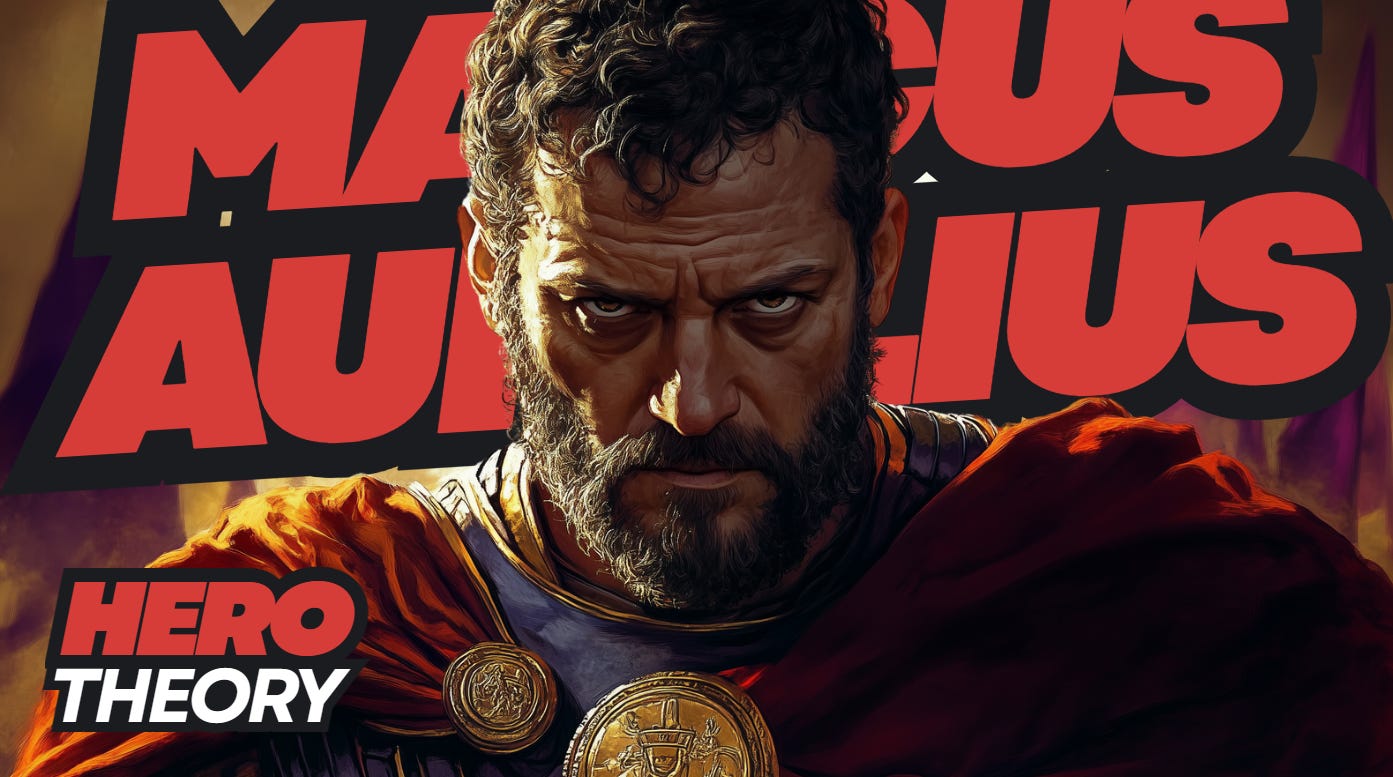
Marcus Aurelius was the Philosopher-Emperor of the Roman world. But the world was not at peace. His armies were stretched thin on the Danube. Germanic tribes pressed hard at the borders. The Antonine Plague swept through Rome, maybe killing ten percent of his people. Senators smiled at dinner and whispered about assassination in corridors. He wore the purple robe, but being emperor was a death sentence waiting to happen.
This was the “normal” world Marcus fell asleep to and rose in the mornings to rule. The empire looked unbreakable on a map, but inside it was bleeding. The economy sagged, coinage got thinner every year, and gladiatorial games distracted the masses while slaves built the wealth.
This Philosopher King, did something strange. He picked up a wax tablet in a drafty field tent along the Danube frontier, and wrote… to himself. Don’t let anger eat you alive. Don’t bow to pleasure. Don’t forget you’re going to die. That’s the Meditations. It feels like a man clawing at the walls of his own head, desperate to stay sane.
Rome preached dominance: take, conquer, indulge. Marcus was training himself in restraint. Rein it in, stay steady, endure without complaint.
For elites, for soldiers, for anyone choking on the excess of empire, it was a way to survive while the world felt more and more insane.
Marcus Aurelius was born in 121 AD, a teen marked early for greatness when Emperor Hadrian noticed his seriousness and had him adopted into the imperial family. He grew up under layers of tutors, drilled in philosophy more than politics, drawn to the Stoics while still a teenager. By 40 he was emperor, ruling alongside Lucius Verus, then alone.
His reign was anything but peaceful: the Parthian War in the east, the Antonine Plague that hollowed out cities, and almost nonstop campaigns along the Danube against Germanic tribes.
His notes reveal a ruler who distrusted his own impulses, grieved children lost to plague, and felt crushed by power, and still stood up every morning to carry out his duty. Again and again he drilled himself: control your judgments, accept fate, do the work before you, remember death, live in harmony with nature. For Marcus, this wasn’t armchair philosophy or a cool Tiktok for likes. It was survival. With wars raging and no confidant safe enough to trust, his notes became one place he could fight and win: over himself.
The years probably exhausted him. He spent more time in muddy camps than in the palaces of Rome. His co-emperor Verus died, his wife Faustina died, plague kept killing, wars kept spreading. He held the empire together with sheer persistence. In 180 AD, at Vindobona or maybe Sirmium (sources differ), Marcus himself fell sick, likely the same plague that had shadowed his reign, and died at 58.
His death ended the line of the so-called “Five Good Emperors.” Into his place stepped his son Commodus, a reckless contrast to his father’s austere strength, remembered as one of Rome’s worst rulers. Marcus Aurelius left no golden age, no empire at peace. What he left was a battered Rome still standing, and a set of private words that outlived all the marble: one man’s fight to keep his soul steady when the world would not stop shaking.
Two thousand years later, you and me feel like we’re in the same rat race. Stoicism is trending on Instagram. CEOs and influencers quote him like scripture. Life feels like that staggering empire again. We don’t have legions and plagues in the same way, but we do have wars, and the rumors of wars, and pandemics. We might have it worse, even when we have it better: You are under siege by notifications, bills, deadlines, algorithms clawing for your attention, companies bleeding you of your money and health. You wake up and the empire is already waiting to own you and tax you.
Most of us weren’t taught how to stand strong against a storm of a thousand cuts that bleeds your attention to a million pieces. No class in school taught you how to carry grief. No mentor showed you how to be steady under pressure. The culture still does what it ever did: indulge, consume, grab everything you can.
That’s why a philosopher-king from 180 AD still whispers: you can have a good life in bad times by mastering yourself.
That’s why Stoicism feels like oxygen to many of us. It’s not escapism. Philosopher Jules Evans says stoicism wasn’t for monks or ascetics—it was designed for soldiers, governors, men in the arena. It’s like Buddhism’s cousin, but aimed at engaging with the world, not retreating from it. The promise is simple: even if the world collapses, you can still stand upright, if you govern yourself.
But maybe here’s the thing. Stoicism braces you, but it doesn’t heal you. Marcus could hold back anger, but he couldn’t turn it into love. He could stare down death, but he couldn’t see resurrection in it. That’s the hand-off. Psychology today digs deeper: we can name trauma, unearth wounds, heal the mind.
Christianity goes even further. It crowns Stoic dignity with something more: you are not just dust mastering yourself, you are beloved. Endurance is good, but communion and brotherhood is better. Self-mastery is noble, but real freedom is surrender to God.
Stoicism is good at sanding down our rough edges. But it stops at the edge of eternity. Marcus tells us: Control your thoughts, accept your fate, be calm in suffering. Christianity says: Yes—but also, you are more than your fate. You are beloved. Your suffering is not just endured; it can be redeemed. Stoicism builds the house, Christianity lights the fire inside and welcomes in angels and the Christ who knocks at the door.
The Aurelius Challenge
Every morning, open your notebook. Write down who you dream of being when things get hard, or go wrong: patient, honest, steady, faithful. Don’t leave it in your head. Get it on the page. Read that every day for a week.
Then go further each time. Close the book, open your hands, and pray: God, I can’t do this alone. Make me the man you need me to be.
Marcus Aurelius carried Rome on his shoulders and his soul in a journal. We can learn the lessons, take the discipline, the clarity, the philosopher-king’s whisper, and offer our efforts to a greater King. Marcus reminded himself to endure, to hold the line. But you were made not just to endure—you were made to rise.
About Hero Theory
Hero Theory isn’t about being the toughest guy in the room. It’s about being the most ready—ready to do the right thing when no one else will. Ready to speak up, step in, and stand firm, even if your hands are shaking. All it takes is 20 seconds of insane courage to change a moment… and maybe even your life.
You can practice that kind of courage. Let's explore what that looks like: the habits, the mindset, the mentors, the fictional heroes and the real-life ones. So when your moment comes, you don’t hesitate. You act. Because that’s who you’ve trained to be.
thank you for another inspirational article / challenge