


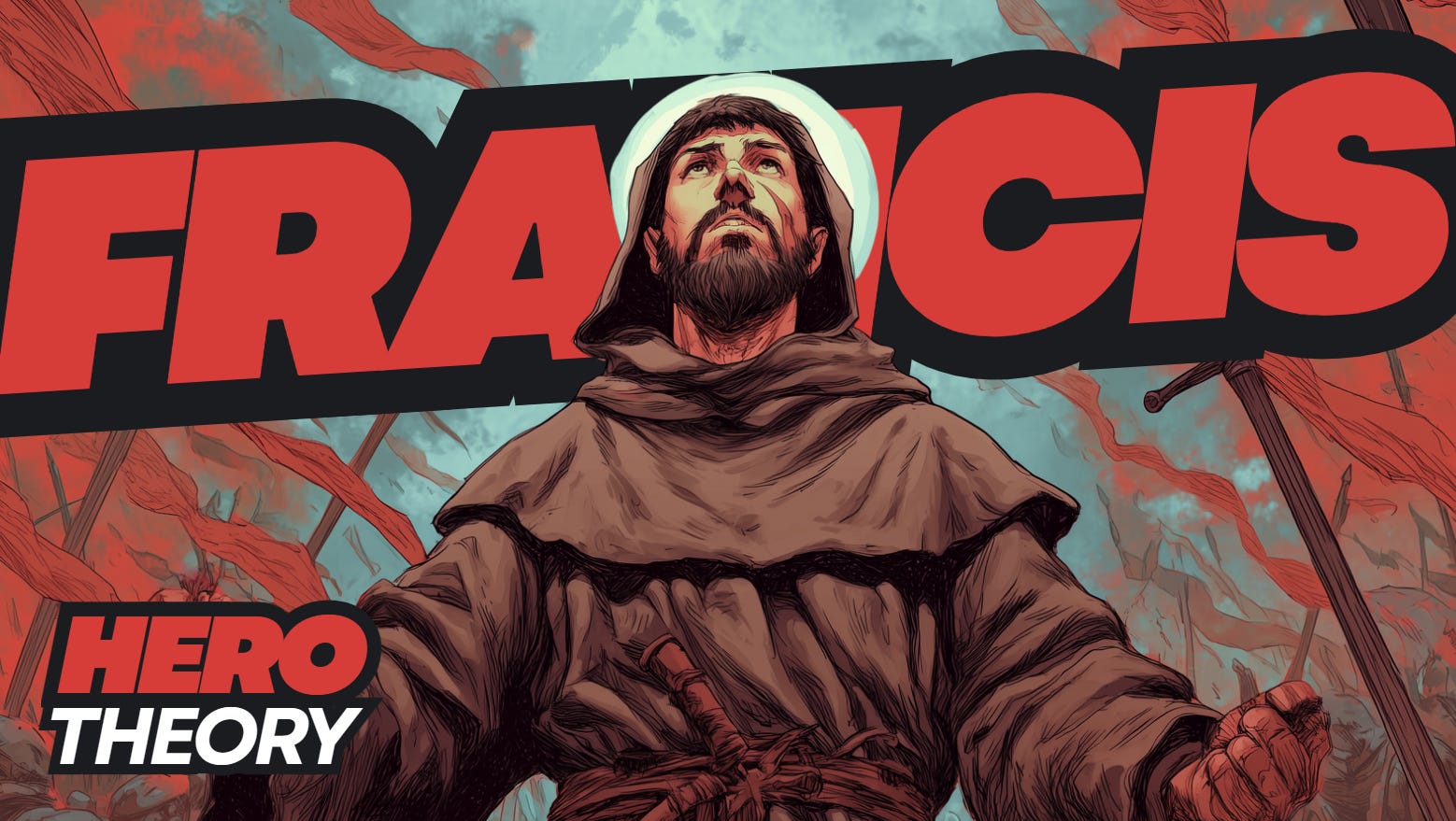
This is a story about two men: one died in a cell in a medieval Italian town, and one went home, but was never the same. And they were the same man.
It’s the Middle Ages, a time of blazing energy. Cathedrals reach into the sky, markets crowded with silk and spices, knights on horseback, troubadours, maidens leading French armies to victory against the English... It was loud, brilliant, alive. Europe was inventing universities, expanding trade, pushing into new lands. And it was cracking.
Wars on every frontier. Crusades, pilgrimages, rumors of more wars always brewing. Nobles scheming, cities tearing each other apart. The Church itself was bloated with wealth for the first time, priests tangled in politics. Everyone wanted systems—bigger armies, tighter doctrines, sharper controls. The world was spinning itself into knots.
And into this world steps Giovanni Bernardone, son of a wealthy cloth merchant in Assisi. The playboy of his town. Francis.
He strutted through piazzas in imported silk, bought rounds of wine for the whole tavern, threw feasts that lasted till dawn, dreamed of knighthood and honor. He was the kid you called if you wanted the party to come alive. Everybody liked him, but nobody would have picked him for anything serious. He was probably all flash, spoiling for battle and glory.
Then war. Assisi finally launched it’s revenge war against Perugia. Francis doubtless headed the columns, in shining armor like an Achilles, head full of troubadour dreams of chivalry, like the Chanson de Roland.
But the banners fell, the horses screamed, the mud filled with blood. Francis was probably dragged from his horse, shackled for a ransom, and stored in a dungeon. And then he spent a year in the dark, chained, watching friends rot, listening to rats gnaw in the dark.
I’m guessing his dreams of glory died in the stench of mildew and iron, and a growing sickness.
In the normal way of things, he would have crawled home from his release, perhaps mustered a fresh squad to join the next army, and returned to raze Perugia to moldering ashes, execute every man and squire who could challenge him again.
He would return as a hero to Assisi, rich with spoil, and spend the rest of his life surrounded by a battalion of guards, looking over his shoulder.
But something broke in Francis in the cell.
A different Francis returned home. He tried to throw himself back into the romp and fuss of fun and revelry. When the papal armies needed soldiers, he hit the road to join the next war in Apulia. But suddenly, insistent dreams of a stunning bride calling him home changed everything.
And then he met a leper. Lepers were the Walking Dead of their time, clutching at clanging bells to warn you away. Like all sane people, Francis would hold his nose and run. It was obvious that God was punishing them.
But this time he stopped. He saw something eternally good and true in that broken human being. He embraced the leper. He kissed the ruined hands. And he said later that what had been bitter in his soul turned sweet.
Soon after, he prayed in a broken chapel, frescoes cracked, roof caved in. There he heard a voice: “Francis, rebuild my Church, which you see is falling into ruin.”
He bent down, picked up a stone, set it on another. Dust on his fingers. Sweat on his brow. Found a way to hold it together with chips of gravel, mortar, and probably his own blood-split hands.
His father beat him, dragged him into court, demanded he obey his father. Francis stripped himself in the public square, dropped his clothes at his father’s feet, and said, “From now on, I will say only Our Father in Heaven.” He walked out of town barefoot. Everyone thought he’d lost his mind.
This was still a world of mafia dons and gangs, playing careful games of pacts and promises and marriage pledges to keep the peace. A world where popes played monopoly with kings over the lives of their armies. It was a world of increasing complexity, Italian Christendom shivering in constant wars and manipulation.
What Francis did next changed Christendom forever.
He took himself out of the game, completely.
He started living the Beatitudes like they were instructions Blessed are the poor? He was poor. Blessed are the meek? He refused power. Blessed are the hungry, the mourning, the persecuted? He lived it all with laughter. He sang in the streets, hugged lepers, begged for food.
And men started following him. First a handful, then hundreds. Barefoot brothers, walking into towns singing, defusing hatred through prayer, attention, and simple begging. They weren’t soldiers any more. They weren’t academics any more. They knew everyone saw them as fools, possibly traitors.
And the world couldn’t resist.
Chesterton called Francis “a giant child.” And children have a way of cutting through everything. While Europe spun its wheels in brilliance and corruption, Francis lived as if Christ was right here, right now, in the dirt, in the leper, in the laughter of brothers. And it shocked people awake. It was a course correction. A reminder of joy.
The Francis Challenge
We live in a time just as tangled. Endless complexity. Politics, technology, culture, traditions... Everyone tells you the answer is clearer systems, more strategies, more control.
But Francis points the other way. When everything gets more complex, sometimes the only way forward is back. Back to basics. Back to the ground under your feet.
Back to the one thing that’s true for every man in every age: you can do the greatest good where you are.
Hug the helpless person in front of you. Rebuild the broken place within reach. Do the impossible act of joy and trust when the whole world is screaming for apocalypse.
Here’s your Francis Mini-Challenge: Look around at your life. I guarantee you’ll see something that’s not fixed, someone who needs help, a project that needs a volunteer.
Go help them out, and don’t ask for anything.
That’s the shockwave men still need today. It’s what you need in your life.
Francis’ story reassures us that even the most unlikely person can change the course of the future.
About Hero Theory
Hero Theory isn’t about being the toughest guy in the room. It’s about being the most ready—ready to do the right thing when no one else will. Ready to speak up, step in, and stand firm, even if your hands are shaking. All it takes is 20 seconds of insane courage to change a moment… and maybe even your life.
You can practice that kind of courage. Let's explore what that looks like: the habits, the mindset, the mentors, the fictional heroes and the real-life ones. So when your moment comes, you don’t hesitate. You act. Because that’s who you’ve trained to be.