


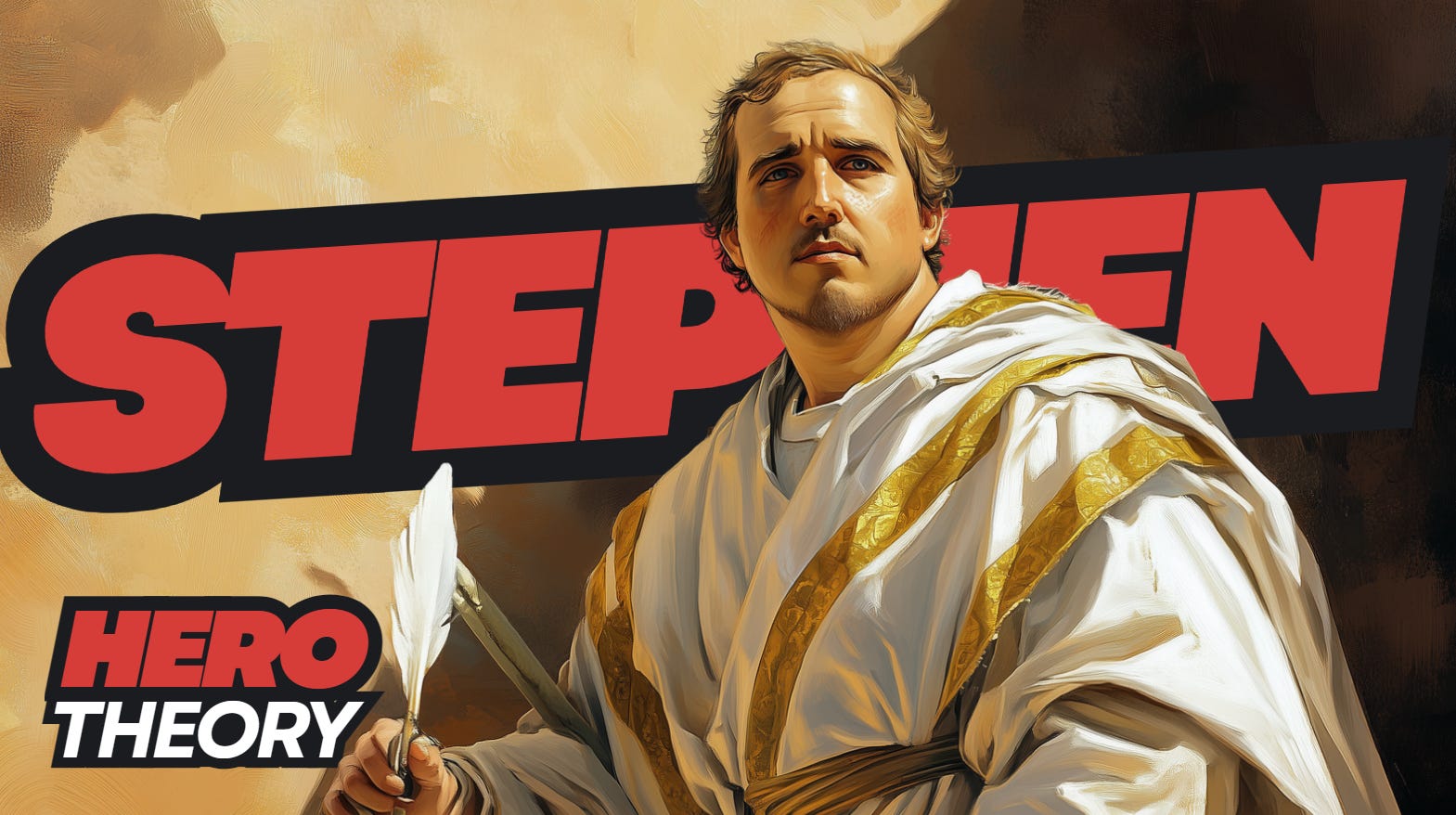
Jerusalem isn’t calm. It’s humming, tense, like storm‑air. Temple courts echo with arguments. Roman soldiers loiter with that bored cruelty soldiers get when they’re waiting for trouble. The Sanhedrin and Pharisees sit tight in their stone chamber, protecting order, protecting prestige, trying to get past the memory of that executed Galilean.
It’s been almost three years, and the rumors won’t die. The tomb story keeps resurfacing. Pilgrims keep slipping in to Gethsemane to touch the rocks blasted with Resurrection radiance. The city is like a powder keg, and Rome is itching for an excuse to march in and restore order.
Into that pressure cooker comes Stephen. He’s not one of the Twelve Apostles. He’s a deacon, and literally chosen to fix a food fight: Greek‑speaking widows say they’re getting shorted at the daily distribution of bread. You don’t get that assignment unless the community trusts you, unless you can read a room and keep fair when people are angry.
Stephen’s name is Greek—Stephanos, probably a Diaspora Jew, bilingual, sharp with Scripture in the Septuagint, at home in the Hellenist synagogues where rhetoric is a sport.
He’s feeding people and keeping mini riots under control in the morning, and by afternoon he’s debating scholars from the Synagogue of the Freedmen, former slaves. And of course, he’s talking about Jesus, the New Kingdom, and that the Temple didn’t stand a chance.
So the Pharisees shaped charges, staged a hearing, drag him into the same kangaroo court that condemned Jesus. Most of us know this only ends one way. Probably pinned to a cross. We would think of the widows, the Freedmen just starting to get it, all our responsibilities. We would bargain. Play for time.
Stephen doesn’t. He tells them their own story: Abraham’s promise, Joseph’s exile, Moses’ call, the prophets’ rage, and then he flips the mirror toward them: Our fathers resisted the Holy One then. You’re resisting Him now.
He knows exactly what he’s doing. Someone has to do it. And in that moment, there’s no one else, there’s nowhere to go, and the right words are on the tip of his tongue.
Then he says he sees the Son of Man at God’s right hand. The chamber erupts. It’s a Hellenist’s case, built from their Scriptures in the Greek he breathes. He’s trying to wake them up. To them, that’s not poetry. It’s a direct claim that the crucified rabbi shares God’s life and power.
They drag him outside the city. Rocks fly. Bone shatters. Dust fills his mouth. And here is the part that brands itself into history: Stephen prays for them. Not for rescue. For them. “Don’t hold this against them.” Blood in his teeth, mercy on his lips. And the sun disappears from sight under a wall of stones.
A young Pharisee watches the coats. Saul of Tarsus. He’s a brilliant Hellenist of his own kind, fluent in Stephen’s same world. He sees the whole thing: the calm, the speech, the prayer. He signs off on the killing and then tries to scrub the movement out of the city. His crackdown scatters the believers into Judea and Samaria—exactly the expansion Jesus promised, triggered by the death of the man he just watched die.
I think Stephen’s voice was already living rent‑free in his head, asking God to forgive him before he even met Him.
What kind of man dies the way Stephen did? Not a fanatic, that’s for sure. A bridge‑builder who refused to bend the truth to keep the bridge. A servant trusted with widows and money, because integrity showed up in his daily life before it showed up in a courtroom. A thinker whose longest recorded speech in Acts is not a flex but a through‑line: Israel’s story fulfilled in Jesus. A Hellenist who proved from day one that this faith wasn’t locked to one language or one province.
He knew the likely outcome and stepped in anyway, because conscience drew a line he couldn’t ignore.
The Stephen Challenge
Don’t hold this against them. In that moment, when everything is pain and ending, that level of self-mastery and forgiveness means only one thing. Training. That’s the kind of line you only get if you’ve practiced forgiving on the small scale a thousand times before. In the bread line, when someone shoves. In arguments, when someone sneers. You let things go, again and again, until mercy is muscle memory. And when the stones finally fly, it’s already loaded on your tongue.
Here’s the challenge: forgive where it is needed. Usually in the small things that we rage-out over.
Write down one thing that ticks you off, and you know it shouldn’t. Tiny is fine. The colleague who undercut you. The friend who ghosted. The driver who made you see red. The person who treats you badly over and over.
Say it aloud anyway: I release this. I refuse to carry this. I forgive them.
Forgiveness does not mean being a doormat. We have to be smart about forgiveness. You must not roll over and continue taking their abuse. Forgiveness is not a ‘get out of jail’ free card for an abuser, because they will spam it to get their way. Be wary of anyone who mix up ‘turning the other cheek’ and letting abuse continue.
When you let a grudge live rent-free in your head, it eats energy. You rehearse conversations, you build imaginary takedowns, you replay the offense like a bad highlight reel. That constant loop keeps your nervous system jacked—higher stress, shallower sleep, quicker temper.
Practicing forgiveness, even privately, snaps that cycle. The brain stops firing the same “enemy spotted” alerts. Cortisol drops. Space opens up. Psychologists call it “emotional regulation,” but it feels simpler: your chest unclenches. You reclaim bandwidth for joy, creativity, prayer, focus.
And here’s the weirdest part: even when nobody hears you say I release him, your subconscious does. You’re re-wiring memory. Instead of the wound being tagged with anger, it gets paired with mercy. Over time, the sting fades. You’re not erasing what happened: you’re changing your relationship to it.
So forgiveness isn’t always for the other person. It’s for you. It frees your nervous system and your soul from being held hostage by yesterday. It keeps you light enough to move forward without dragging chains behind you.
Do that daily and you build Stephen’s reflex. He had practiced being free on the inside, no matter what happened to him, or what people said about him.
He didn’t set out to be a martyr. He set out to be faithful. And when the storm finally came, the man he had been in the small rooms is the man who stood in the big one.
About Hero Theory
Hero Theory isn’t about being the toughest guy in the room. It’s about being the most ready—ready to do the right thing when no one else will. Ready to speak up, step in, and stand firm, even if your hands are shaking. All it takes is 20 seconds of insane courage to change a moment… and maybe even your life.
You can practice that kind of courage. Let's explore what that looks like: the habits, the mindset, the mentors, the fictional heroes and the real-life ones. So when your moment comes, you don’t hesitate. You act. Because that’s who you’ve trained to be.
'I refuse to carry this' ... with other drivers ... I'll get plenty of chances to develop this muscle