


For Garrett Hines, heroism isn’t bravado, but obedience under pressure, from the little-known story of Beninus walking into fire, to the brutal realities faced by Saint Patrick in pagan Ireland. He recounts his own collapse as a missionary overseas, the complete loss of prayer that followed, and how Catholic traditions rebuilt his interior life. Hines maps a handful of heroes — saints, statesmen, warriors, and fictional kings — united by their refusal of comfort and willingness to suffer for what mattered. He closes with a blunt charge to modern men: go all in, because anything less than a life aimed at holiness will eventually fail.
A story “most men and most Catholics don’t know”
“Let me tell you a story about a guy that most men and most Catholics don’t know… and that’s Beninus,” Hines said.
It starts with St. Patrick in a duel with druids, in an Irish castle trying to convert a king.
“For those that don’t know, druids in ancient Ireland — basically like magicians, religious leaders,” Hines said. “They’re the ones in charge of the spiritual practice of Ireland.”
The king agrees to hear Patrick out, but only if there’s a test. “The only way to know if your God is greater than the God of my druids,” Hines said, “is to have a test.”
A well-known druid challenges Patrick to a contest — a series of events to prove whose god is real.
First, the druid demands snow. “He tells St. Patrick, he says, ‘Call on your God and cover the land in snow.’”
“St. Patrick looks at him and he says, ‘No, I’m not going to act against God’s will. I will not do that,’” he said.
The druid does it anyway. “He calls on whatever he calls on and he casts his incantations and he covers the entire land in snow,” Hines said. “The whole land is now covered in snow.”
Patrick answers with a direct challenge. “‘Make the snow go away.’”
The druid stalls.
“And the druid says, ‘No, I can’t do that. I can’t do that until… tomorrow afternoon.’” Hines laughed at that. “You’re just waiting for it to get hot. That’s cheating.”
Patrick draws the line between death and life. “All you can do is bring death,” Hines said, again voicing Patrick. “But my God brings life.”
He said Patrick prays and then— “the whole land is right back to just how it was before snow.”
The contest escalates.
“Okay, well cover the whole land in darkness,” the druid demands.
Patrick refuses again. The druid summons darkness anyway. “He casts his spell, calls forth a series of demons, covers the whole of the castle in darkness,” Hines said.
Patrick tells them to end it. For some reason, the druid can’t.
“Then St. Patrick prays,” Hines said, “and of course the light returns and the demons flee and the darkness is gone.”
The king pushes for an ultimate test.
“We’re gonna have a contest by water,” Hines said, describing the plan. “We’re gonna take both of your holy books. We’re gonna throw them in the lake. Whoever’s book comes out unharmed, their God is the real deal.”
The druid refuses. “Nope, I refuse, absolutely not, not gonna do it,” Hines said. “This guy serves the God of water. Not gonna play around in his game.”
So the king offers fire instead. “We’ll have a trial by fire. We’ll throw the holy books under fire and whoever’s book comes out —”
The druid refuses again. “Absolutely not,” Hines said. “Every other season, this guy serves the God of fire. I’m not gonna compete with that.”
Beninus and the test men don’t want
In Hines’ telling, Patrick finally proposes something the druid thinks he can win.
“We’re gonna build a hut,” Hines said. “Half of that hut is gonna be brand new green wood. The other half is gonna be completely dry, kindling.”
Then Patrick sets the terms. “You [the druid] get to go into the green part,” Hines said. “And I’ll tell you what, you can even wear my cloak.”
“And my student,” he continued, “a guy named Beninus, he’s going to go on the other half with all the dry kindling and he’ll wear your cloak.”
“Then they will set the whole thing in fire,” Hines said.
The druid agrees, guessing it’s an easy win.
“But then all the green wood burns to the ground— nothing of the druid, not an ash is left, except for St. Patrick’s cloak,” Hines said.
“And Beninus stands in the dry wood,” he said. “The dry wood’s completely untouched. He’s untouched, but the druid’s cloak is gone and it’s completely burned off him him.”
“As men, like we want to be St. Patrick,” he said. “We want to go toe to toe and duke it out with evil and be supermanly. And we are called to that. And that’s a hundred percent legitimate desire.”
But Hines kept insisting on the other role. “There are other times where we’re called to be the student that’s like asked to do the crazy things,” he said. “I can’t imagine how hard that would be.”
“I think we miss those opportunities where we’ve been asked as men to just say yes to a task,” he said.
“That’s the story of Beninus,” he said. “I love that story. I love the conflict with a druid, but the whole of it is just, I wanna be the guy that says yes to what God asked me to do.”
Why Patrick mattered to him
“When we [Garret and his wife] converted to Catholicism, and I needed to choose a patron saint for confirmation, I landed on St. Patrick,” he said. “In part because he’s Irish and that’s amazing. And I have Irish ancestors.
“But it wasn’t the Irish part so much,” he said.
He wanted someone who understood darkness. “Because I needed somebody that understood what it meant to be asked to go and be a light in dark places,” he said.
“St. Patrick is not Irish, he’s English,” he said. “At the age of 16, he is captured by a bunch of Irish raiders, taken off and sold into slavery where he basically serves as a shepherd for six years.”
“At the end of that six years, he receives a vision from God,” Hines said, “and after receiving the vision from God runs 200 miles across the island to a boat he’s never seen before.”
He said Patrick escapes, recovers, then gets asked to go back. “While he’s there recovering, he has a vision in which God basically asks him to go back to the land of his enslavement, to share the gospel for the rest of his life,” Hines said.
He said Patrick commits.
“If you read his confessions, he is adamant,” Hines said. “Basically, they’re going to have to bury me here because I’m not leaving.
“And St. Patrick showed up to Ireland and drove Satan out of Ireland,” he said. “It is the real light stepping into the darkness.”
“We sold everything we had”
Dominic asked him for one of the most difficult decisions he’d ever made.
Hines said the first, hard-seeming decision was actually easy. “Before my wife and I were Catholic, we were non-denominational evangelical missionaries,” he said. “And it was actually a rather easy decision to sell everything we own.”
They had a young son, and his wife was pregnant.
“We took our then four-year-old son and our five-month in the womb daughter,” he said. “We were somewhere in five to six months pregnant and we sold everything we had, rehomed two dogs, sold our house, and moved overseas for mission work.
“That was actually really easy because we knew in our gut that’s what God was asking us to do,” he said.
Then it went bad. “About six months in, we were there and things started to go really badly,” he said.
“We were in Southeast Asia,” Hines said. “I loved it,” he said. “It’s amazing and it’s a beautiful country and a beautiful place. But It was also the first time I’d ever been warned about which parts of town you go to because you’re American,” he said. “If the police figure out you’re American, they’ll probably force you to pay exorbitant bribes. So don’t get caught.”
Then came the verdict.
“About six months in, we were basically pulled aside and said, hey, you’re not good enough to do this,” Hines said. “And that was quite a punch to the face.”
“I would probably pin it as: I was not submissive enough,” he said. “I don’t handle authority really well.”
He laughed at the category. “How many creative people out there do authority very well?” he said.
“Wrestling with God”
Dominic said it sounded like a Christian pattern: rebels wrestling with authority.
Hines agreed, and he defended the fight.
“I think there’s real value, as hard as it is, the wrestling with God is in part what God wants,” he said.
He used a father-and-son image. “I would rather my son fight it out with me over something,” he said. “I would rather have that fight with him than him walk off and not talk to me.”
That leads to a line he can’t shake.
“My three favorite words in the Bible,” Hines said, “Jesus is talking and he says, ‘you who are evil know how to give good gifts to your kids. How much more?’”
He said he wants that tattoo. “I really want that tattoo on my body,” he said. “How much more does God know how to give good gifts to his children?”
Then he made the connection.
“So when I think about things like I would rather my son fight it out with me — well, how much more does God want me to fight it out with him?” he said.
He refused the polite version of faith.
“I think we underplay wrestling in the faith a lot because we wanna go, we wanna be pious, we wanna do the things, we wanna check the right appropriate boxes,” he said.
He named the wrestlers.
“Every major player in the Bible — Abraham, Moses, Isaac, Jacob, Peter, Isaiah, David, Paul — they all wrestle with God,” he said. “They all go toe to toe.”
He said the purpose is authenticity.
“They want to know that the thing that they’ve put their everything in is authentic,” he said. “And I think you can’t get there without the wrestling.”
“We were undertaking a task that… was wrong”
Hines said the mission work wasn’t only hard; it felt misdirected. “We were undertaking a task that in my heart, I really believed was wrong,” he said.
He said the pattern was common: short-term teams arriving, declarations of belief, no support after.
“Groups of people would come in, take over established kind of a religious beachhead,” he said. “The people in the area would be like, yeah, sure, we totally believe. And then nothing about their life would change.”
He described what he feared they were building. “It became this ‘parfait’ of religious beliefs,” he said. “I became vocal that what we’re doing, we’re not doing it the right way,” he said. “We could be doing this better.”
Looking back, he said he didn’t have the wisdom to handle it privately. “I didn’t have the wisdom or the prudence to realize this is a conversation I need to have in private,” he said.
“We were basically told… you’re not equipped for this,” he said.
He described the next month as one of the darkest. “I had a brand new baby. She was a month old,” he said. “My son is four.” They were exposed to the community burning trash round their home all the time.
His wife was breaking under stress.
“My wife is staying up basically 24/7 because she’s so stressed out, and she couldn’t nurse our daughter well enough to keep her body weight up,” he said. Their daughter nearly went to the hospital. “She’d lost 15% of her body weight in the first two weeks,” he said. “Thankfully some things got put in place.”
He started thinking survival, not vision.
“We got to go back home,” he said. “But I don’t have a job. We don’t have anywhere to live. I don’t even know if we’re going to have any money,” he said. “I started drinking NightQuil at night just to get a few hours of sleep,” he said.
They made it home, found a job, but it was a dark time. Their counselor later helped them realize they’d endured spiritual abuse.
“We came home and we sat in the back”
Dominic asked if their faith community back home wanted them back.
“Well, normally, when missionaries in that community come home, it’s a big deal,” he said. “They’re brought up in front of the whole church, they’re prayed over, they’re celebrated, they’re touted as heroes.”
“And we came home and we sat in the back and… nobody knew we were there,” he said. “And nobody said, welcome home.”
“It was just miserable,” he said.
He said they didn’t want to stay.
“I think I would have tried to out of pride,” he said, “just to stick it out. But a really good friend of mine told me that I need to pray and ask God to just open one door.”
He said God did. “He gave us one door and that brought us to where we are now.”
“As a Protestant, I hated prayer”
Hines said the door didn’t just change his geography. It changed his interior life.
“I love what I’m doing right now,” he said. “I’ve always wanted to be a professional artist.”
He said he pushed his art harder when he started teaching and became a father. “When I’m painting, I feel alive the most,” he said.
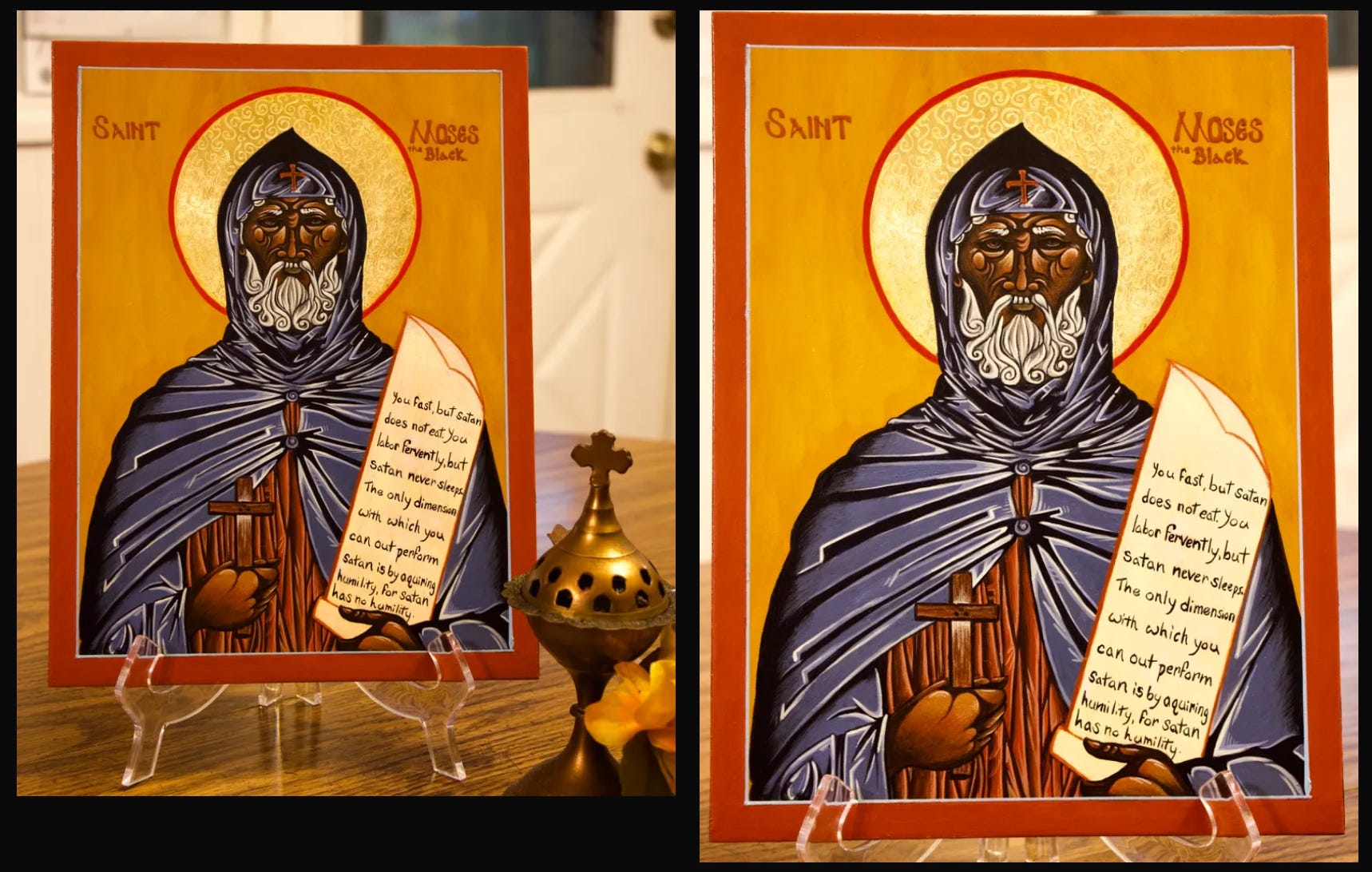
“I’m an iconographer,” he said, “and iconography is an ancient, sacramental art form that really at the heart of it is about helping people pray.”
Which was ironic. “As a Protestant, I hated prayer,” he said. “I mean, with every fiber of my being.”
“One of my avenues for creative expression is poetry,” he said. “Prayer a lot of times for me felt like trying to craft just the right words.”
He described the mindset.
“I have to get the right words in order,” he said. “If I can just get the right words in order and I do it at the right time with the right feeling and the right expression, then God will do the thing I need.”
Public prayer made it worse.
The mission crisis broke it.
“I remember talking with the team leader telling him that prayer doesn’t matter,” he said. “If I pray, nobody cares. Because you’re gonna ‘pray’ and we’re gonna do what you wanna do,” he said. And God’s gonna do what he wants to do anyways,” he said. “So why should I even ask?”
He quit.
“And it was at that point I completely just quit,” he said. “No prayer, I’m done.”
Then he described the reversal.
“And now my whole world revolves around prayer,” he said.
He explained how icons reframed it.
“Icons are really windows into heaven,” he said, “that help us to see the glory of God. Through those windows, we get pulled into the reality of who God is so that it shapes us,” he said. “And the whole purpose of that is a life of prayer.”
“Becoming Catholic is what changed me.”
“What I discovered was all the written prayers,” he said. “As Catholics, we have written prayers like we have the stars.
“It was like a cold drink of water in a Texas summer,” he said, “because I don’t have to think anymore. I can just attach the intention of my heart to these beautiful words that somebody (infinitely smarter than me) came up with,” he said. “And I could just say that.”
He said the Jesus Prayer anchored him. “Lord Jesus Christ, Son of God, have mercy on me a sinner,” he said, calling it “the prayer of the heart.”
He quoted Evagrius as a daily habit. “Prayer doesn’t have to be all that complicated,” he said. “All you really need to say is, ‘Lord, as you will, and as you know, have mercy.’”
“And then he goes on to say, if things get really hard, just say, ‘Lord help,’” Hines said.
He said one line can change you if you mean it.
The rosary: quitting, then coming back
Hines said the rosary was his “gateway drug for converting.”
After a first intense year, he hit a wall.
“I remember going really hard,” he said, “like four rosaries a day.”
Then he quit that. “After 30 days, I thought, man, I can’t do this,” he said. “I’m not seeing any fruit from this. This is crazy.”
“For a whole year, I quit the rosary and just did the Jesus Prayer,” he said.
Then he described what came back, and how. “This last summer, I have no clue what happened,” he said, “but it’s like a rhythmic hum in my soul. I realized I need to pray the rosary,” he said.
He commissioned a rosary from a woman at his parish — and she refused payment. “She would absolutely refuse to let me pay her for it,” he said. “And it is my favorite rosary.”
He named a Marian title that stuck. “Our Lady Undoer of Knots,” he said. “That’s probably my favorite title for the Blessed Mother actually. My past and my background have a lot of knots,” he said. “And so it’s a real joy to go to her and to say, mother, I need this stuff to be undone.”
Who are your heroes
Hines said he prays the Irish circling prayer every morning, and he starts by asking a small group of saints to pray for him.
He listed them without a strict order: St. Augustine, St. Charles de Foucauld, St. Thomas Aquinas, St. George the Dragon Slayer, St. Maximus the Confessor, St. Peter Julian Eymard, Blessed Fra Angelico.
He added St. Valerian — “the lesser known half of the partnership with St. Cecilia.”
Cecilia gives her heart to Christ early, takes a vow, is forced into marriage, and warns Valerian that an angel protects her. He can’t see it unless he’s baptized.
“St. Valerian agrees to be baptized then and there” he said. “In the moment of his baptism when he comes up from the water, he sees her angel.”
“I imagine a fierce, fiery, multi-winged behemoth of an angel that would make every man pee their pants,” he said.
After that, Valerian, Cecilia and Valerian’s brother roamed at night to bury murdered Christians. “They would go out and they would find the bodies and they would give them a Christian burial,” Hines said.
The men were caught and martyred. “They refuse to give up anybody and they are martyred.”
Hines said he wanted Valerian in his circle because of what he saw as husbandly protection. “He was so dedicated to Cecilia,” he said. “Very much a St. Joseph figure: ‘I’m gonna protect this woman.’
“To me, that is quintessential masculine husbandry,” he said. “First and foremost, it’s protecting the beauty of your wife.”
He explained why he calls the group an honor guard.
“I imagine it a lot like an honor guard,” he said. “I need people around me who know what they’re doing far more than I know what I’m doing to be on my protection.”
Roosevelt, Lincoln, Aragorn, and Musashi
Hines didn’t stop with saints.
“As a man and as a leader,” he said, “I highly respect Theodore Roosevelt.”
He framed Roosevelt as the man who refused comfort.
“If you look at the list of things he has done in his lifetime,” he said, “you’d be hard pressed to find somebody who took very seriously the call to make the most out of every minute of your life.”
He said he wants his own life to look like that.
“When I finally pass through the veil,” Hines said, “I want people to look back at my life and be like, my gosh, this guy never sat down.”
He talked about the artist stereotype — flaky, unreliable — and admitted he sometimes needs a day with “complete lack of structure.”
Then he described Roosevelt as the corrective.
“If I took my energy seriously and I took the things that God has given me to do seriously,” he said, “would I rather be sitting down watching TV or would I rather be out there writing or out there painting or out there chopping firewood or out there practicing this craft?”
He named Lincoln next.
“I admire Lincoln a great deal,” he said, “partly because he was willing to put people around him who disagreed with him.”
He described Lincoln’s leadership amid conflict as a character test.
He said his wife gave him a book of Lincoln quotes and he keeps going back to how Lincoln talked about masculinity, faith and leadership. “I think he was a once in a century human being,” Hines said.
Then he turned to fictional role models. He named Aragorn, and told men to actually read Tolkien.
“If you’ve only experienced Lord of the Rings in the movies,” he said, “you are not getting the real Aragorn. You’re getting a very watered down Aragorn.”
He described the book moment he loves: Frodo commits to the fellowship in Rivendell, Aragorn swears his sword, then turns to Elrond. “Time for me to be the king,” Hines said, quoting the posture. “Give me the sword.”
He said Aragorn has doubts but doesn’t stop being who he knows he is.
“This is who I am and this is what I’m called to be,” Hines said. “Give me the sword.”
Then he named Miyamoto Musashi, calling him both historical and legendary. “He’s a real life Japanese swordsman,” Hines said, describing the two-sword style and the discipline that made Musashi compelling to him.
“He wrote a book called The Five Rings,” Hines said. “If you’ll just be disciplined in how you live, you will live well.”
He summarized the ethic he’s drawn to.
“Forget comfort, pursue difficulty,” he said.
Who he’d sacrifice for
Dominic asked the final question: who does Garret aspire to be a hero for — and wouldn’t allow the “God card” or “family card.”
He pointed to a men’s community called F3. “If you’re out there and you’re looking for something very manly, I would encourage you to look up what’s called F3,” he said. “It stands for faith, fitness, fellowship.”
He said he trains with the group “two or three days a week” and would “absolutely lay down and sacrifice” for them.
He described a workout that very morning. “It was just the most terrible suffering,” he said. “And I loved every minute of it.”
He focused on the detail that mattered: men finishing together.
“Guys would jump in and they would keep doing the workout next to the guy who wasn’t finished just so he wasn’t training alone,” he said.
“And he would finish and then he would do his last circle run,” Hines said, “and all the guys got in line with him to run with him.”
He said the group always ends in a Circle of Trust. “We literally stand in a circle together,” Hines said. “If you’ve got a prayer request, if you’ve got something in your life that is awful,” he said, “this is now a sacred time where I’m gonna get to say the things out loud that I’ve been holding.”
He compared the feeling to confession — not the sacrament, but the seriousness.
“I’ve said things in the Circle of Trust, I wouldn’t say to anybody else,” he said. “Because I know it stays in that circle.”
Then the boundary. “Once the prayer is over, Circle of Trust is over,” he said. “Even as a group, we won’t talk about it again.”
He said he prays for what he’s heard but doesn’t pry. “I don’t text them about it. I don’t ask them about it,” he said.
He said men carry too much alone.
“There are a lot of guys in the world who are holding onto a lot of things,” he said, “simply because they don’t have somebody in their life who bonds with you over shared suffering.”
He compared it to the closeness formed by military suffering, while saying he wasn’t equating them.
He said he’d respond immediately if any of them needed help. “If those guys ever said they were down and out and needed help, I would be right there.”
Closing advice: “Go all in”
Dominic asked for 60 seconds of closing advice.
“Go all in,” he said. He said men are “too easily distracted and comfortable.”
“If you really, really want to suck the marrow out of life and grow in your faith,” he said, “go all in.”
He made it practical.
“Whatever that looks like for you — whether it’s getting up early, whether it’s exercise, whether it’s prayer, whether it’s scripture — whatever the thing is, don’t settle for ‘this is okay,’” he said.
Then he raised the standard.
“Anything other than sainthood will not be enough for me,” he said. “Whatever that takes.”
“If you’re out there and you’re thinking ‘I’m stuck, how do I get unstuck?’” he said. “Go all in, go absolutely full throttle, pursue God completely unabandoned.”
He promised difficulty and meaning. “It will suck, it will be hard and it will not be fun all the time,” he said. “But it will be absolutely meaningful.”
“And that is worth more than comfort,” he finished.