


Bill Moyer told Catholic men’s leaders that the next era of men’s ministry must move beyond gathering men into programs and toward forming brothers who make disciples, outlining a seven-year mission built around one repeatable pledge: pray daily, connect weekly and invite monthly.
Billy Moyer had spent the opening keynote describing a leader’s movement from his “shadow” toward “daylight,” the place where self-awareness allows him to recognize fear, ego and destructive patterns before they control him.
His father gave the metaphor a name.
“The daylight has a name,” Bill Moyer told the room.
He asked the men to repeat it.
“Jesus.”
“That’s the light,” Moyer said. “‘I’m the way, the truth and the life.’ Follow in that light.”
For Moyer, the greatest threat to leadership is pride. A man can begin with a desire to serve and gradually allow ego to take over. The answer, he argued, requires more than private self-examination.
It requires another man.
“You need a brother to speak truth to you in a way like you never heard it before,” Moyer said. “And you need to man up and give them permission to do it.”
That brotherhood, he said, is part of the reason the leaders had gathered.
A man walking toward Christ needs men around him who can recognize when he is moving toward ego, sin or isolation and call him back.
Moyer connected that journey with the language Heroic Men has chosen for its mission.
A heroic man, he said, is “a saint in the making.”
The destination is sainthood. The work happens while men are still becoming saints.
Are you making disciples?
Moyer then tested the room.
“How many of you in the room would consider yourself a disciple?”
Hands went up.
Then he gave them another question.
“I want you to write down the names of three or four or five people that you’ve discipled.”
The distinction went to the heart of his message.
Jesus told his disciples to go and make disciples. For Moyer, receiving formation without eventually bringing another person toward Christ leaves the mission unfinished.
“That journey is meant to do one man at a time and go out in twos,” he said. “That’s what real leadership is. It’s inviting.”
He pointed to the simplicity of Jesus’ invitation.
“Come.”
Then:
“Come and see.”
Catholic men, Moyer argued, can make the work more complicated than it needs to be. They build programs, conferences and resources while overlooking the power of one man personally inviting another.
The biblical model also challenges the instinct to carry the mission alone.
Jesus formed the disciples before sending them, Moyer said, and then sent them in pairs.
“He sent them out in pairs, in twos,” Moyer said.
The principle matters because men frequently default toward independence.
Moyer illustrated it through his grandson Lincoln, who had reached the age when he increasingly tells adults, “I can do it myself.”
Men often retain the same instinct for decades, Moyer said.
His answer was brotherhood.
A call that began in youth ministry
Moyer’s own path into men’s ministry began after 14 years working in youth ministry with his wife.
He loved the work and struggled with the idea of leaving it.
Then, while praying about what came next, Moyer said he received a clear direction.
“God said, ‘I want you to work with men.’”
His first response was resistance.
“I said, ‘I don’t like men.’”
Years of youth ministry had shown him the consequences when fathers became absent, distracted or disengaged.
Moyer remembered prayer circles where teenagers cried over their fathers: fathers who failed to show up, fathers who treated their wives poorly, fathers who stood at the back of activities distracted by work and networking.
He was angry with those men.
Then came the answer.
“What he said is, ‘I want you to go tell men that.’”
Moyer began to see the previous 14 years differently.
“I realized that youth ministry wasn’t my destination,” he said. “It was my training. It was my preparation.”
The following day, his friend Robert Tunmire approached him after meeting with the bishop about the lack of organized ministry to men in the Diocese of Austin.
The bishop had responded by asking Tunmire when he planned to start something.
Tunmire came to Moyer.
“I feel like you and I are supposed to do this together,” Moyer recalled him saying.
The partnership eventually helped launch the Central Texas Fellowship of Catholic Men.
Moyer described Tunmire as the forceful “Paul” of their partnership and himself as “Barnabas,” the encourager and teacher.
Learning to accept that role, he said, became part of his own formation.
Twenty years later, that local ministry continued under other leaders.
For Moyer, its survival carried an important lesson: founders have to let the work belong to the mission rather than themselves.
Catholic men have tried this before
Moyer then widened the lens.
The attempt to organize Catholic men in the United States stretches back more than a century, he said.
He traced one early national effort to the National Council of Catholic Men, established in 1920 under the National Catholic Welfare Conference.
The organization was created to promote the lay apostolate and Catholic action.
It eventually merged with the National Council of Catholic Women into a broader lay organization.
Within several years, the men’s organization had disappeared.
Moyer said the effects lasted for a generation.
Later efforts emerged.
In the late 1990s, Catholic men returning from Promise Keepers gatherings began discussing the need for resources specifically designed for Catholic men.
“They said, ‘We’ve got to organize. We have to do something,’” Moyer recalled.
That effort became the National Resource Center for Catholic Men.
The founders initially imagined large gatherings, but Moyer said they eventually identified a more important question: Where does a man go after the conference?
“The magic doesn’t happen at the conference,” he said. “Only the call, only the ‘come,’ comes at that, and then you’ve got to put the work in after that.”
The organization produced resources and eventually became the National Fellowship of Catholic Men, moving beyond content toward leader support and fellowship.
That organization later ceased operating in its previous form.
From those relationships eventually emerged the Catholic Men’s Leadership Alliance.
Moyer said the recurring history carries a warning.
Groups can begin around cooperation and gradually become preoccupied with their own identity, attendance or growth.
“Why does history repeat itself?” he asked.
His answer was pride.
Stop counting the wrong number
Moyer challenged leaders to reconsider how they measure success.
A pastor may proudly say that a parish with 1,000 families has a men’s group drawing 12 or 15 men.
Moyer argued that the number leaders should care about is the hundreds of men still outside the room.
“How many members are part of their men’s group?” he asked.
“All of them.”
The men attending are only the men currently reached.
The mission includes the rest.
“Jesus didn’t say go and make disciples of 10 or 13 or 15 men,” Moyer said. “He said all of them.”
That principle became central to the Catholic Men’s Leadership Alliance.
The organization, Moyer said, was designed as an alliance because no single ministry, conference or apostolate could reach every Catholic man.
The movement needed groups working together.
Its later development, however, introduced another complication.
When Heroic Men became confused with a platform
During the COVID era, the alliance gained an opportunity to build the digital platform that became Heroic Men.
The platform provided Catholic content specifically for men and eventually developed into an extensive collection of talks, series and ministry resources.
Moyer called its development both a blessing and a curse.
The blessing was infrastructure.
The problem was identity.
As men increasingly encountered Heroic Men through a website or app, many began to understand Heroic Men primarily as another content platform.
That made the alliance appear to be another ministry competing with existing Catholic men’s organizations.
Moyer said that was contrary to its purpose.
The original name, Catholic Men’s Leadership Alliance, reflected three ideas.
“Catholic men” identified whom they were trying to reach.
“Leadership” meant forming men who could form others.
“We’re going to go make disciple makers,” Moyer said.
And “alliance” meant working with ministries already serving men rather than trying to replace them.
Heroic Men, he said, exists to equip those leaders and ministries.
“We’re going to pull all the things that already exist and everything new that comes, and we’re going to become an alliance,” Moyer said.
He repeatedly returned to the scale of the unfinished mission.
Even large Catholic men’s organizations, he argued, reach a fraction of the men around them.
The answer is cooperation.
The next seven years
Moyer said the organization has spent roughly a year and a half working to clarify that identity and determine the central mission for its next seven years.
The destination is 2033.
That year marks 2,000 years since the events of Christ’s death, resurrection and the apostolic mission that followed.
Heroic Men wants to use the years leading to that anniversary around one measurable goal:
1 million men.
“Our mission for the next seven years: a million men,” Moyer said.
The goal, however, is larger than registering 1 million names on a platform.
Heroic Men wants 1 million men practicing a common rhythm of Christian brotherhood.
Moyer summarized the mission:
“Heroic Men exists to turn isolated Catholic men into brothers who draw nearer to Christ and to one another through one simple sharable pledge to pray daily, connect weekly, and invite monthly until 1 million are living it by 2033.”
The strategy is designed to work inside existing parishes, conferences, apostolates and ministries.
It begins with a man choosing other men.
Pray daily
The first part of the Heroic Pledge is prayer.
Moyer originally considered asking each man to pray for as many as 10 men, though experience suggested three may be easier for many men to carry consistently.
The point is specificity.
Choose men by name.
Pray for them.
Then tell them.
A man might approach someone after Mass and say he has been praying for him and ask whether there is something specific he can bring to prayer.
Moyer described young fathers in his own parish with several children, crowded schedules and little likelihood of attending an early morning men’s group.
That does not place them beyond reach.
He can approach them where they already are.
He can pray for them.
He can learn what burdens they are carrying.
The relationship begins there.
“Draw near to Christ every day,” Moyer said.
Prayer happens before crisis becomes the only reason a man turns toward God.
Connect weekly
The second action is personal connection.
Once a week, the man reaches out.
The interaction can be a phone call, coffee, a conversation after Mass or another direct encounter.
“Real brotherhood in person,” Moyer said.
The man becomes more than another face in a parish.
His needs have a name.
His struggles become known.
The relationship can eventually lead toward deeper fellowship, a men’s group, spiritual formation or another ministry.
For Moyer, this is where Heroic Men’s national infrastructure has value.
The organization has developed a map of men’s ministries and groups and wants to help connect men with leaders already working in their communities.
The digital system serves the personal encounter rather than replacing it.
Moyer said a man touched by a story online ultimately needs “a brother sitting next to” him.
Invite monthly
The third action creates multiplication.
Once a month, a man invites someone else into the pledge.
Moyer offered the kind of invitation he imagines:
“I’ve been praying for you. Would you be willing to pray for three other guys sitting all around you, guys in your life that need prayer?”
Then those men begin the same rhythm.
Pray.
Connect.
Invite.
“This is how it multiplies,” Moyer said.
A conference with 500 men could therefore become much larger than an annual gathering of 500 attendees.
If those men each begin praying for three others, the ministry suddenly touches another 1,500 men.
Those relationships can feed future conferences, parish groups and other ministries.
Heroic Men wants to provide the infrastructure behind that expansion while allowing each local ministry to retain its identity and relationships.
‘We make it stronger’
Moyer repeatedly emphasized that the pledge is designed to layer onto existing ministries.
“No competition, no new curriculum,” he said.
Heroic Men already has media, group directories, coaching, conferences, speakers and other resources.
Those tools serve the central mission rather than becoming the mission themselves.
“We make it stronger,” Moyer said of existing ministries.
The pledge is the shared action that can cross organizational lines.
A parish men’s group can use it.
A conference can use it.
A diocesan ministry can use it.
An individual man can begin without waiting for a program.
Heroic Men, Moyer said, can support ministries with leader development, communications and connections to men in their regions.
The movement depends upon leaders seeing one another as collaborators rather than competitors.
One man, then the next
Near the end of the presentation, Moyer brought the strategy back to the men sitting in front of him.
“The movement moves at the speed of the leaders,” he said.
If the men carried the pledge home, it could spread.
If they guarded their organizations, contacts or influence, growth would remain limited.
Moyer asked the leaders to take the pledge themselves, bring it into their parishes and regions, and invite another man every month.
The scale of the vision is national.
The mechanism remains personal.
“One man then another,” Moyer said.
The goal is 1 million men living the pledge by 2033.
The promise, as Moyer put it, is simpler:
“Build brotherhood one pledge at a time.”
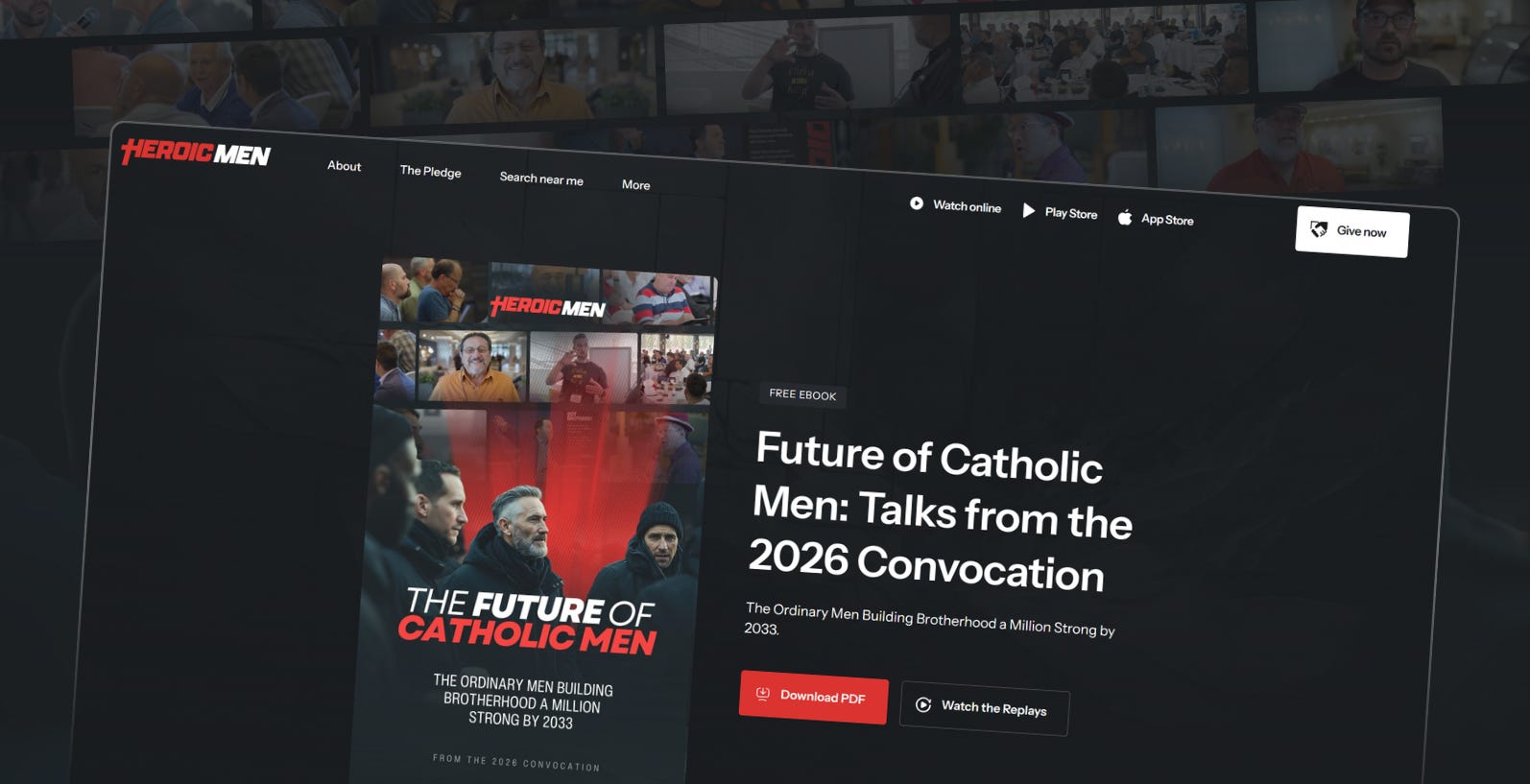
This talk is one of many from the Heroic Men: Future of Catholic Men 2026 Convocation. Get the replays and the PDF ebook free, here.